
The Wand in Hand:Expression, Power and Agency at The Handbag Factory
By Yuwan Cao, with additional reporting by Qian Luo
12 August 2026
On 6 August, The Wand in Hand opened at The Handbag Factory in London. The exhibition was organised by SIURUEI ART, founded by Xiaohui Wu, who also curated the show. It brought together 48 artists from China, the UK, the US, France, South Korea, Japan and Brazil. The works included painting, sculpture, ceramics, photography, moving image, installation, performance, fashion and jewellery.
The opening programme included music, live performance and artist talks. Curator Xiaohui Wu described the ‘wand’ as a metaphor for the ability to express, question and make one’s voice heard. Rather than representing one fixed form of power, it asks what happens when that ability is placed in someone’s hands. Guest cellist William Lui performed J. S. Bach’s Cello Suite No. 3 in C Major, BWV 1009. Junyi Liu performed Mouth Order during the opening, while GUANGUAN invited visitors to take part in repairing Fú Lù. Several participating artists also spoke about their work and practice.
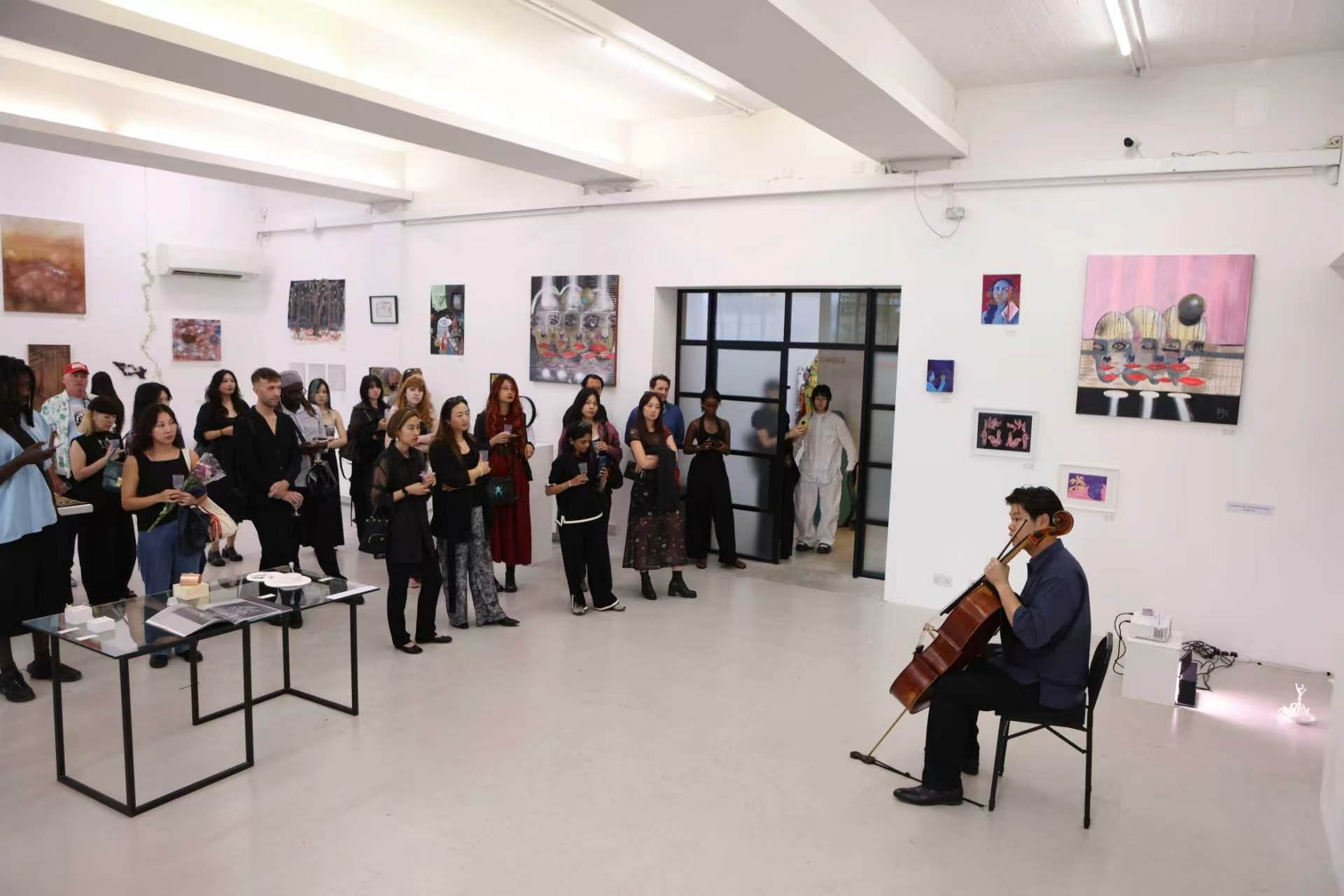
Behind the exhibition is SIURUEI ART, a London-based platform founded by Xiaohui Wu, whose practice moves between China and the UK. Working across disciplines, her projects often bring together artists from different contexts without forcing them into a single narrative. That approach carries through here, where connections between works emerge gradually rather than being explicitly defined.
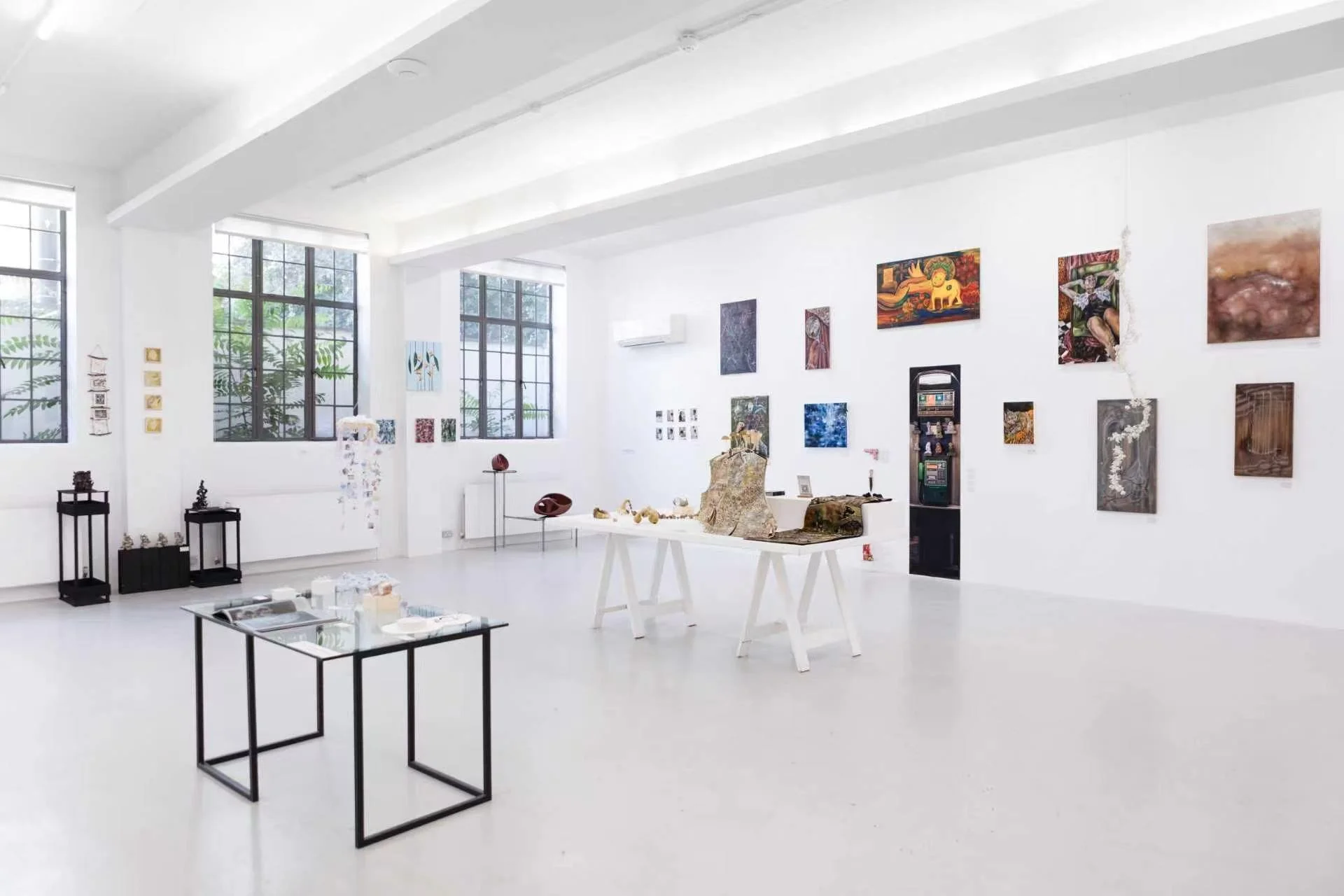
The exhibition was arranged around five walls forming a loose enclosure, with two display tables at the centre of the room. Wall-based works appeared alongside sculpture, publications and wearable pieces. Some walls were more densely hung than others. The largest wall held a denser group of works, while quieter areas and the central displays created more space between individual pieces. Visitors moved along the walls from one work to the next, while the central displays allowed them to look more closely at objects.
On the first wall, several works drew attention to the body and the traces it leaves behind. Jiaqi Lyu’s Shining Crocodile was one of the first works visitors encountered near the entrance. In the dark-toned painting, the fossil appears almost black, with pale highlights giving the remains a metallic sheen. Rather than appearing as a static specimen, the creature seems to continue moving across the surface.
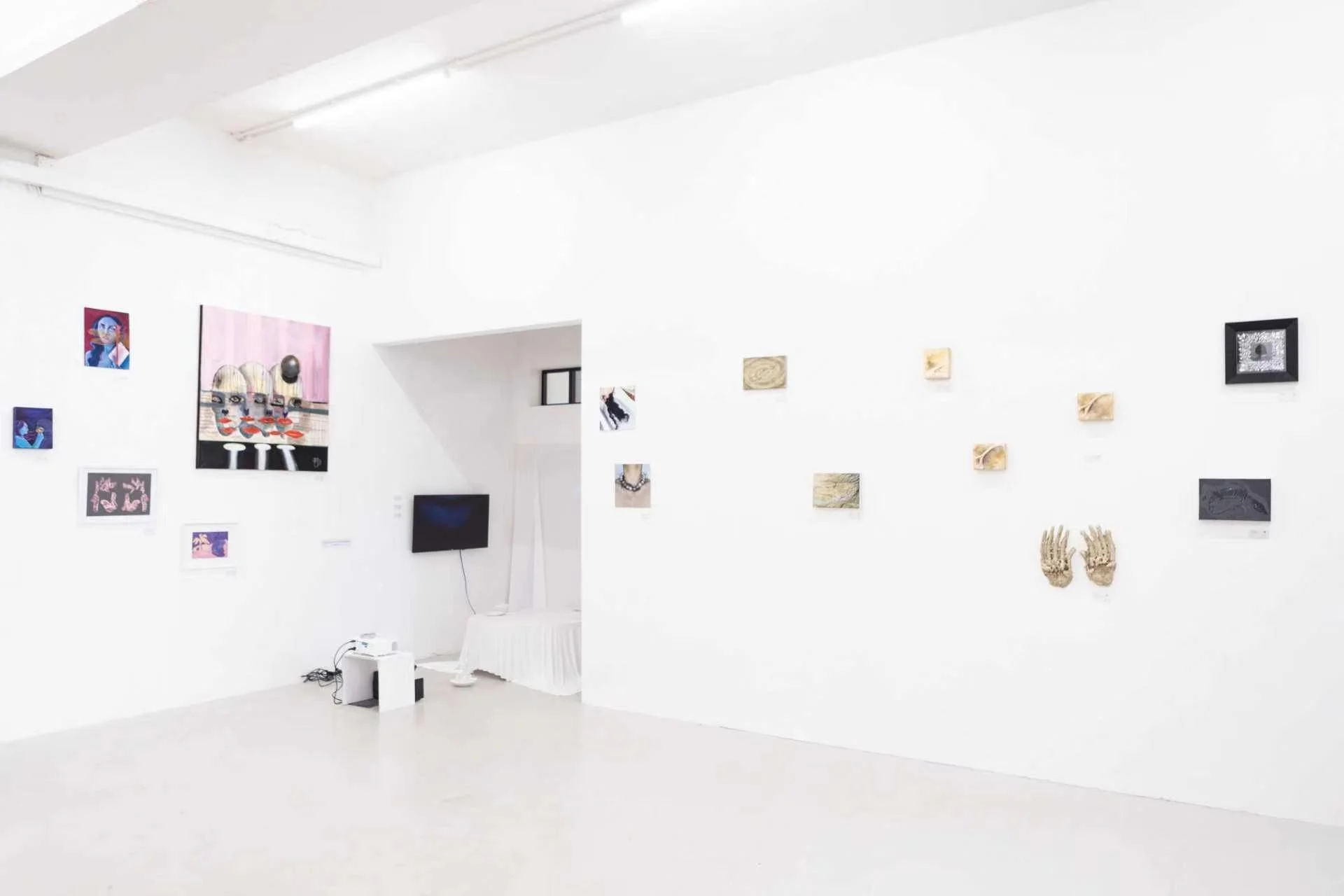
Jingyun Guan’s Above Skin turns to something more private. The two photographs place body hair in different settings and against different materials. Hair is familiar as part of the body, but when it appears somewhere unexpected, that familiarity quickly becomes strange.
Junyi Liu’s Mouth Order was activated in a live performance during the opening. Two performers sat opposite each other at a dining table and shared a meal before using the white, bone-like device at the centre of the work. What began as a relatively intimate exchange gradually developed into a physical struggle, as the performers competed for control of the device and, with it, the authority to give commands at the table. The table and projection formed the setting around them, while the escalating actions brought questions of family authority, obedience and refusal into the performance. Rather than showing what followed from winning, the performance focused on the struggle for that authority itself.
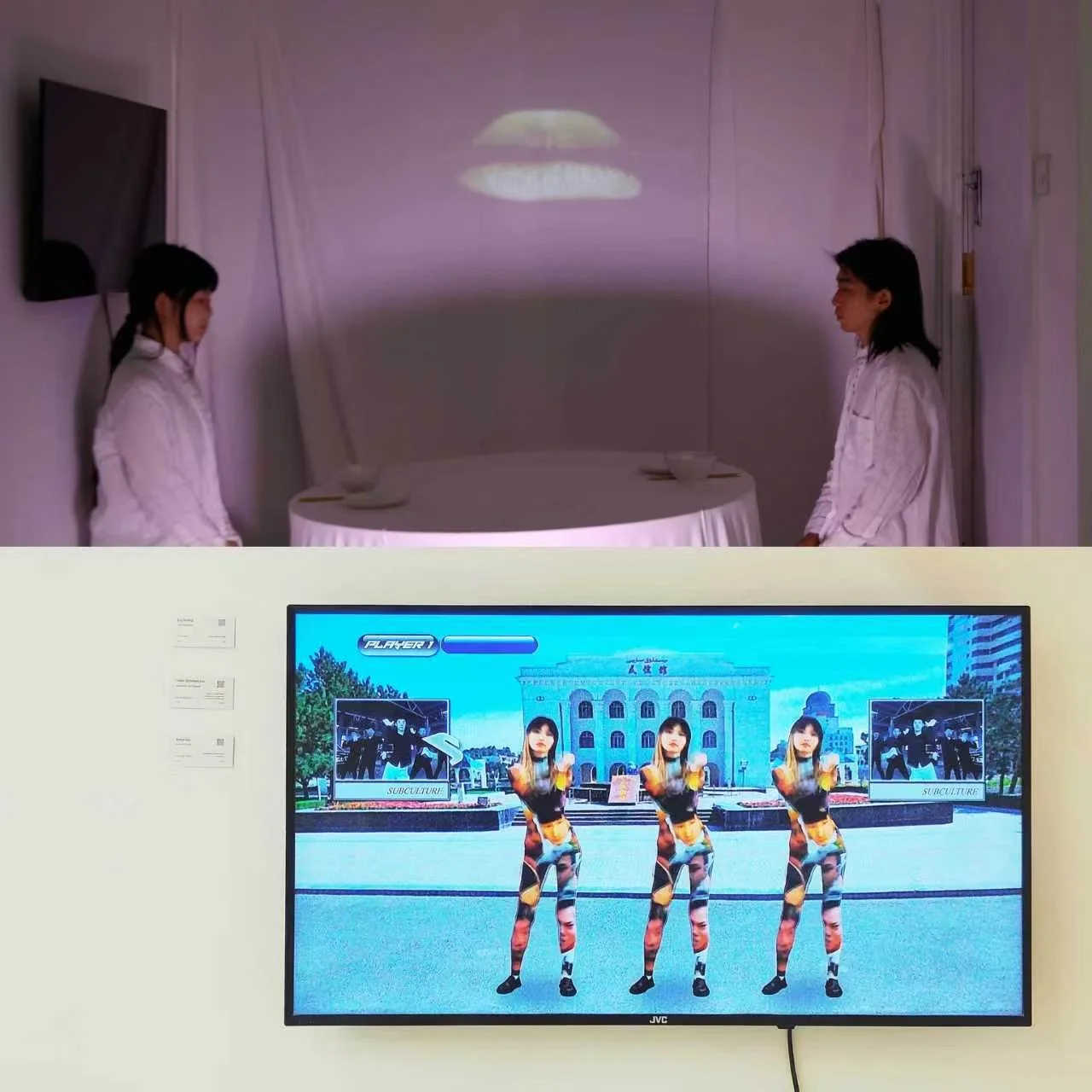
Joy Wang’s Social Shake is a 90-second video presented in the format of a game. After a character selection screen, two figures enter a dance battle: one represents shehuiyao (社会摇) and is labelled ‘subculture’, while the other, dressed in a school uniform, performs movements associated with school exercises under ‘mainstream culture’. The video incorporates music, dance clips and scrolling comments familiar from short-video platforms. Reactions range from ‘so stupid’ to ‘I think it’s funny’, reflecting the different judgements that appear around such online content. In the end, shehuiyao wins the battle.
Across the room, the gallery’s largest wall created another strong visual grouping. Facing the entrance on this wall was Mai Muraguchi’s Unnamed. Eight ceramic heads were arranged beneath a printed poster modelled on a Japanese public telephone booth. Each head carried a label drawn from actual pink flyers, small advertisements for sexual services that once circulated widely across Japanese cities. These included phrases such as 不倫一夜妻 (‘one-night affair wife’), 半分少女 (‘part girl, part woman’) and 2回戦OK (‘second round available’). Mai cast both the faces and their labels in ceramic, translating categories taken from disposable street advertising into sculptural objects that visitors could examine closely.
Nearby, Louise Hapton’s Deadly Magical Girls also uses ceramic, but moves in a different direction. Pink surfaces and the visual language of the ‘magical girl’ are applied to guns, knives and boots, combining cuteness with objects associated with force and violence. The weapons are mounted on the wall, while the boots are placed on the floor. Placed together, Mai and Louise’s works can be read as a progression. Mai presents women through the categories imposed on them by an advertising system, while Louise’s armed ‘magical girls’ turn a language of femininity and cuteness into one of resistance. The pairing sets up a broader line of inquiry across the wall around the female body, power and the structures that seek to define it.
Daniela Marques’s The Lord’s Prayer was also shown on this wall. The work consists of eight photographs from a performance in which a woman drinks, cuts salami, eats part of it and shares the rest with the audience. The knife, food and act of sharing recall religious ritual, but here these actions are carried out by a woman. The work places a familiar ritual structure in a female body and questions the authority traditionally attached to it.
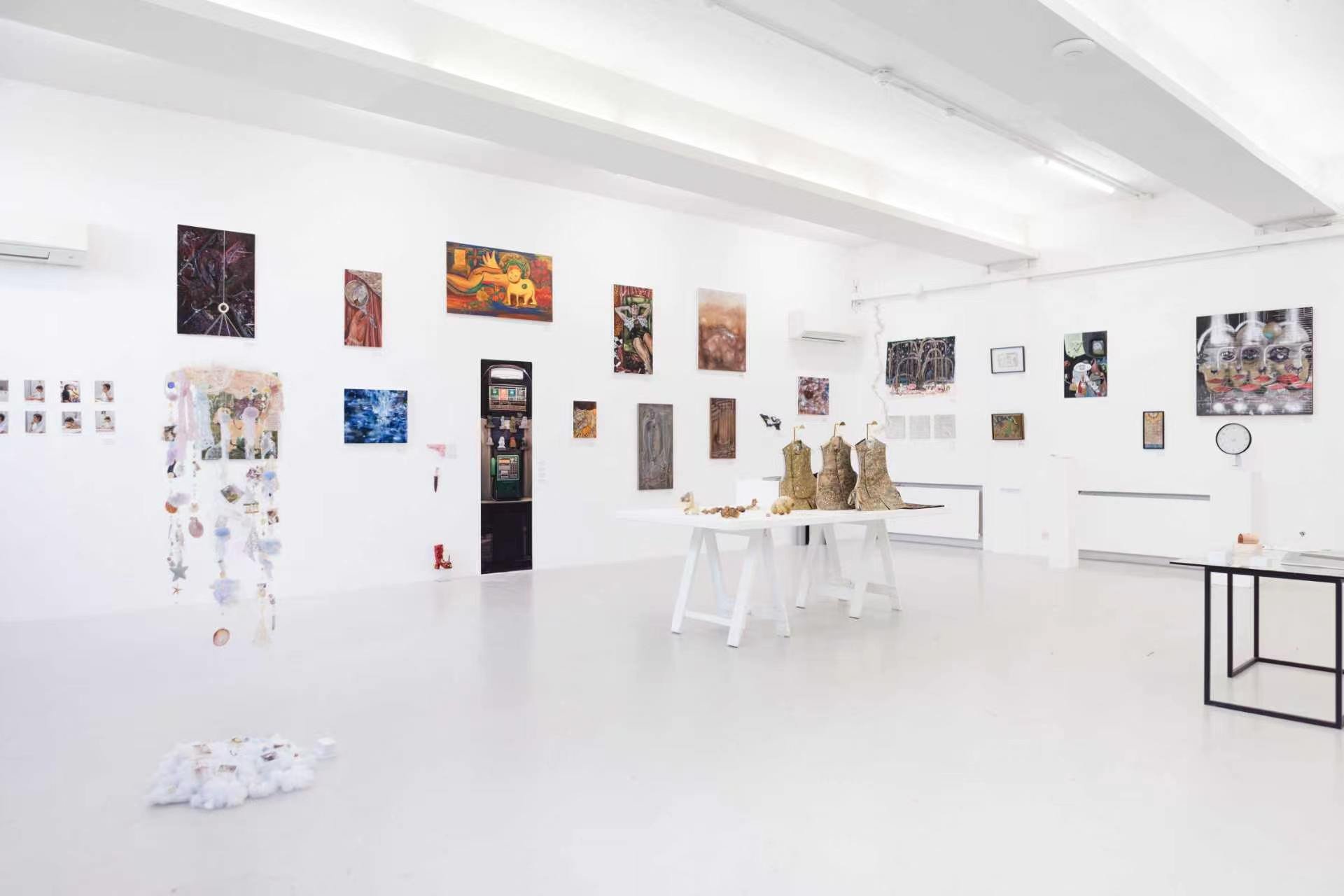
At the centre of the gallery, Yimeng (Jade) Liu’s Refuge series draws on her grandparents’ experience of leaving land they had long lived on as a result of urban expansion. Corn leaf fibres and reclaimed cardboard were made into wearable pieces that sit close to the body. The pieces are earthy yellow, with flower-like and ring-shaped forms that appear light and fragile.
Further along the walls, Verona Shi’s ceramic sculptures Body 1 and Body 2 appear as two brick-red forms of different sizes. Their rounded structures are cut through by openings of varying scale, creating a network of cavities and passages that twist and overlap through each piece. The openings make the space inside the sculptures as visible as their outer surfaces.
Can-Fen Wang’s Angry Wildfire is a red aluminium sculpture formed from three irregular, looping bands. Their jagged lines rise and fall around the circular structure, while red lacquer is interrupted by blackened areas and touches of gold leaf, giving parts of the surface a scorched, flame-like appearance. The forms draw on waveforms taken from recordings described as ‘objective’ and ‘angry’. Through these contrasting lines, the work considers how opinions accumulate and intensify online, where information can become entangled with emotion.
Fú Lù developed from an incident described by GUANGUAN in which the gourd sculpture was damaged during an inspection. A later complaint and the public discussion around it brought both support and online abuse. For the exhibition, the damaged work returned to a public setting. During the opening, visitors were invited to help repair it, turning an experience that began with one person into a shared action.
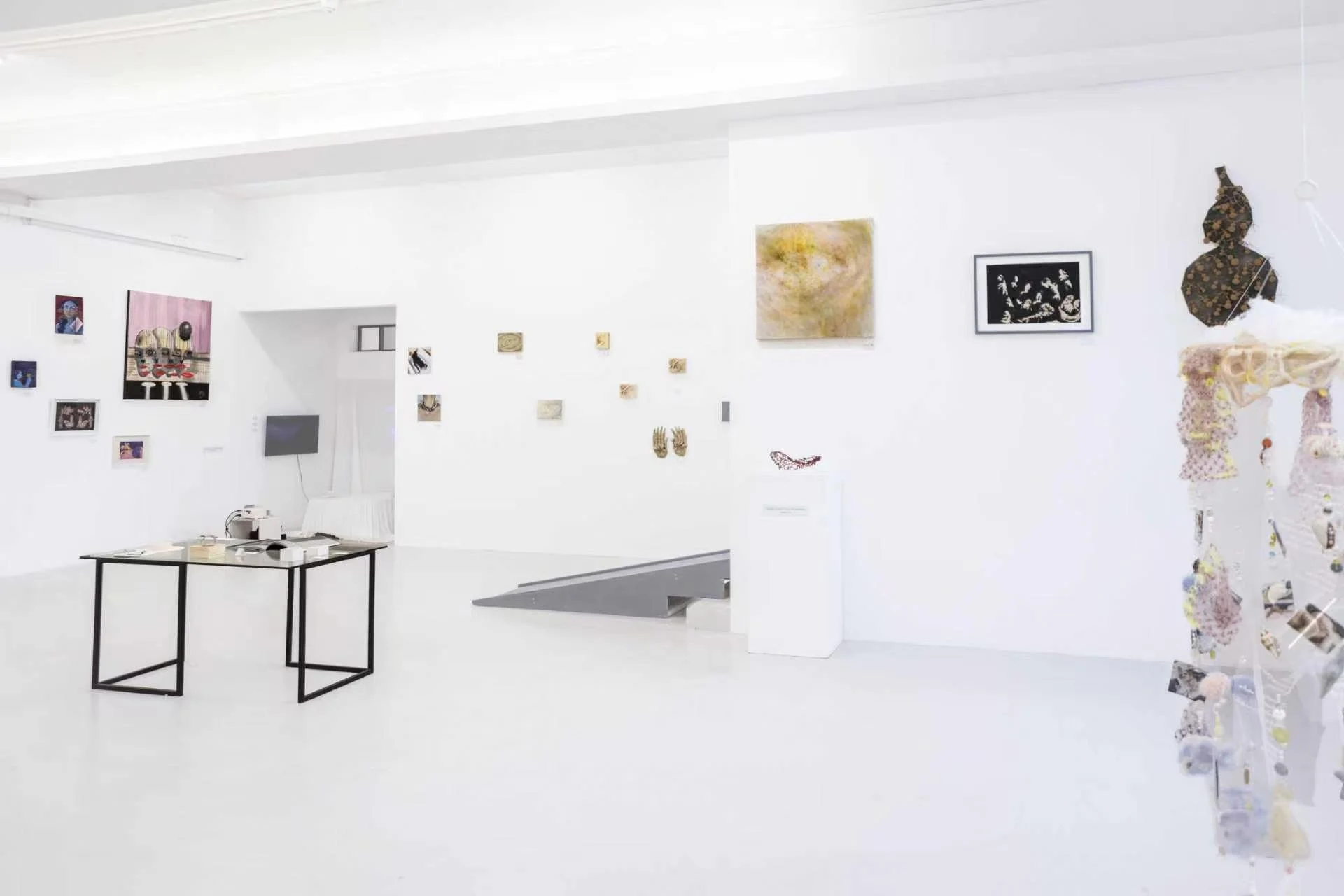
Across the exhibition, the ‘wand’ takes different forms: a body, an image, an object, a performance, a memory, or an action shared with others. What connects these works is not a single answer, but the possibility of using expression to question what surrounds us, to respond to systems, and to make space for another voice. The question raised at the beginning therefore remains open: when expression is placed in someone’s hands, how will they use it?
Exhibition Information
The Wand in Hand
The Handbag Factory, London
6–10 August 2026
Curated by Xiaohui Wu
Presented by SIURUEI ART
Curator Assistants:Xiangyu Zhang(Lead)& Yuwan Cao
Intern:Qian Luo
Community Collaboration: SheTalksArt
Collaborating with JustArt Collective Newspaper
Collaborating with Floral Artist: Claudia Pang
Collaborating with Cellist: William Lui
Participating Artists:
Xueer Bi, Yueqiao Chen (Lila), Brea Freeburn, GUAN GUAN, Jingyun Guan, Louise Hapton, Ao Han (Hano), Shiyuan Hu, Ela Hsu, Luzi Jin, Willem Keys, Sona Kharel, Szu-Ting Kuo, Eunji Lee, Yuexuan Li, Lihui Liang, Xueqing Liang, Xuke (Emilia) Lin, Yifei Lin, Junyi Liu, Yimeng Liu (Jade), Madeleine Love, Jiaqi Lyu, Winter Ma, Daniela Marques, Imogen Marsteller, Mai Muraguchi, Chancy Pan, FAN PAN, Claudia Pang, Aida Pouryeganeh, PJ Riley, Verona Shi, Estelle Simpson, SOEY, Bahar Talebi Najafabadi, Qinglai Tom, Can-Fen Wang (Sunny), Jia Wang, Joy Wang, Shuwen Wang, Yuxuan Xiao, Freja Jiahui Ye, Xinwei (Vita) Ye, Isabelle Zetterström, Hongru Zhang, Liang Zhang, Yiyuan Zhang.
