
Who Are We When Others Are Looking
Adrian Piper and the Performance of Unstable Identity
By Will Yu
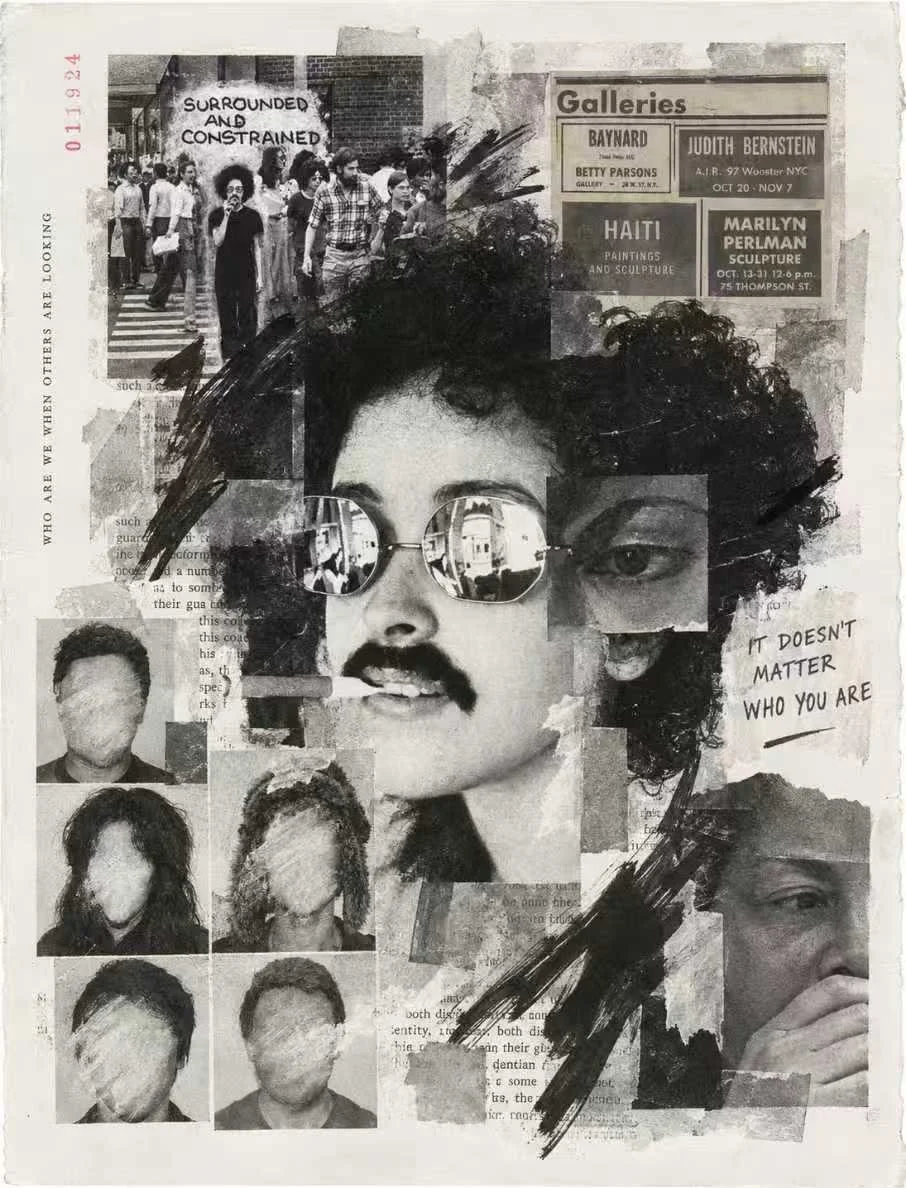
A figure moves through the streets of New York wearing a short curly wig, reflective sunglasses, a moustache and dark trousers. The body is slightly hunched. The gestures appear controlled and deliberately masculine. At first, the figure seems to offer a clear identity. Yet the longer we look, the less certain that identity becomes. This is The Mythic Being, an alter ego created and inhabited by American conceptual artist and philosopher Adrian Piper between 1973 and 1975.
The Mythic Being was not confined to a gallery. Piper appeared in this form at public and private events, allowing the character to enter spaces where people were not necessarily expecting to encounter art. The project also developed through black and white photographs, drawings and a series of advertisements placed in the gallery section of New York's Village Voice. In these advertisements, the figure appeared with speech bubbles containing sentences taken from Piper's private journal. Each month, she selected one sentence and repeated it like a mantra until its original personal meaning began to change.
Through this movement between the street, the photograph and the printed page, The Mythic Being occupied an uncertain position. He was fictional, but he entered real social spaces. He emerged from Piper's own memories, but appeared to possess an identity separate from hers. The work therefore asks a question that remains difficult to answer: does identity come from within the individual, or is it produced through the ways a body is seen and interpreted by others?
At first glance, Piper's transformation appears to depend on a small number of visible objects. A wig, a moustache and a pair of sunglasses alter how her body is read. Yet these objects do not create the character on their own. The viewer completes the transformation by attaching assumptions to them. Clothing, posture, race and gender become social signals. Together, they allow strangers to place the body within familiar categories before they know anything about the person in front of them.
This is where the work becomes more than an act of disguise. Piper does not simply perform another identity. She exposes the speed with which society performs identity upon the individual. The Mythic Being could be read through existing stereotypes surrounding masculinity, Blackness, class and aggression. The public encounter made these assumptions visible, not because Piper explained them, but because the audience carried them into the work. The body became a surface onto which social expectations were projected.
Judith Butler's theory of gender performativity, developed years after Piper began this project, offers one way of understanding this process. Butler argues that gender does not appear natural because it comes from a stable inner truth. It appears natural because particular gestures, forms of dress and ways of behaving are repeated until they become socially recognisable. Performativity is therefore not the same as an individual freely choosing a role. It describes the repeated social actions through which identity becomes believable.
The Mythic Being gains force through this repetition. Piper did not wear the costume once and reveal the illusion. She returned to the character over a period of years. She repeated his gestures, carried his body into different situations and circulated his image through public media. The identity became convincing because it continued to appear. Through repetition, a collection of constructed signs began to resemble a coherent person.
At the same time, the work does not suggest that identity can be changed without consequence. Piper may have been able to remove the wig and moustache, but the racial and gendered structures exposed by the performance could not be removed so easily. Some identities are chosen, while others are assigned. Some forms of transformation create freedom, while others reveal the limits placed on a body. The instability of identity does not mean that every person can move between social categories with equal safety or control.
Stuart Hall's writing on cultural identity extends this discussion beyond gender. Hall describes identity as a production that is never complete and is always in process. From this perspective, identity is not a finished object hidden inside the self. It is shaped through history, representation and the positions from which we are seen. The Mythic Being makes this process physical. Piper's private journal becomes a public speech bubble. An intimate sentence is transferred to another body, circulated in a newspaper and interpreted by strangers. What began as personal memory becomes part of a wider social encounter.
This transformation also complicates the relationship between performance and documentation. The live encounters have passed, but photographs and advertisements continue to circulate. These images appear to preserve the character, yet they also produce new versions of him. A photograph removes the movement of the body and the immediate reactions of the street. It can make an unstable performance appear fixed. At the same time, each new context invites another reading. Documentation does not simply record the performance. It performs the identity again for a different audience.
The work feels particularly relevant at a time when identity is constantly edited across physical and digital spaces. A profile photograph, an accent, a uniform or a job title can quickly determine how a person is understood. For people moving between cultures, languages and institutions, the self may feel intimate and continuous, but it is never entirely separate from the world in which it is formed. A person can appear confident in one space, foreign in another, professional at work and almost invisible within the labour that supports that professional image.
Performance art gives these ordinary adjustments a visible form. It can slow down the gestures that usually pass unnoticed and reveal the structures behind them. Through The Mythic Being, Piper does not provide a more authentic identity beneath the costume. Instead, she shows that the search for a single authentic self may itself be misleading. The figure remains suspended between Piper's body, the character she constructs and the meanings created by those who encounter him.
When Piper removes the wig, moustache and sunglasses, The Mythic Being appears to disappear. Yet the codes that produced him remain. The performance leaves us with an uncomfortable possibility: identity is neither entirely ours to possess nor entirely imposed from outside. It is continually negotiated between how we inhabit our bodies and how those bodies are read by others. Perhaps the unstable self is not a problem that needs to be solved. It is the condition through which we move, adapt and become visible to one another.
References
Butler, Judith. Gender Trouble: Feminism and the Subversion of Identity. Routledge, 1990.
Hall, Stuart. Cultural Identity and Diaspora. In Identity: Community, Culture, Difference, edited by Jonathan Rutherford. Lawrence and Wishart, 1990.
MAMCO Geneve. Adrian Piper: The Mythic Being. Exhibition text, 2017.
The Museum of Modern Art. Adrian Piper, The Mythic Being, Village Voice Ads, 1973 to 1975.