
The Structural Echo: Tracing the Poetics of Geometry and Cultural Erasure in the Work of Esha Malik
Art Review Article by Jenny Ping Lam Lin
In contemporary visual discourse, the act of concealment is rarely a declaration of absolute absence; rather, it is a site of hyper-visibility where power, lineage, and trauma perform. To flatten a culturally specific artifact is to leave an indelible, structural trace—a lingering ghost that refuses to be fully absorbed by the mechanisms of systemic homogenization. This dialectic between the visible and the suppressed stands at the very core of Esha Malik’s research-led practice. Operating within the fluid yet acute boundaries of cultural hybridity, the South London-based artist deploys a disciplined "textile logic" and digital masking to interrogate how inherited craft and cultural vernaculars navigate the grinding pressures of time, distance, and historical displacement. Anchored by her dual background in Politics and International Relations alongside her achievements as a published poet, Malik approaches the frame not merely to create decorative forms, but to transform the visual surface into a critical site of socio-political commentary.
Malik’s distinct visual lexicon synthesizes the regional subversions of South Asia—ranging from Phulkari embroidery and Rangoli geometric principles to the grand architectures of Mughal palaces and early Hindu temples. By subjecting these loaded historical symbols to repetition, tessellation, and digital manipulation, she tests the endurance of cultural memory against the systemic flattening of global narratives. Each of her digital prints functions as a critical archive that asks what continues when a specific form is worn down by history. Through her meticulous layering, Malik reveals that the suppressed voice always leaves a friction—a muddy, indelible mark embedded within the geometry itself. Her art calls the viewer to be a witness, inviting us into a space where the trace of a structure persists as an echo of what it once specifically was.
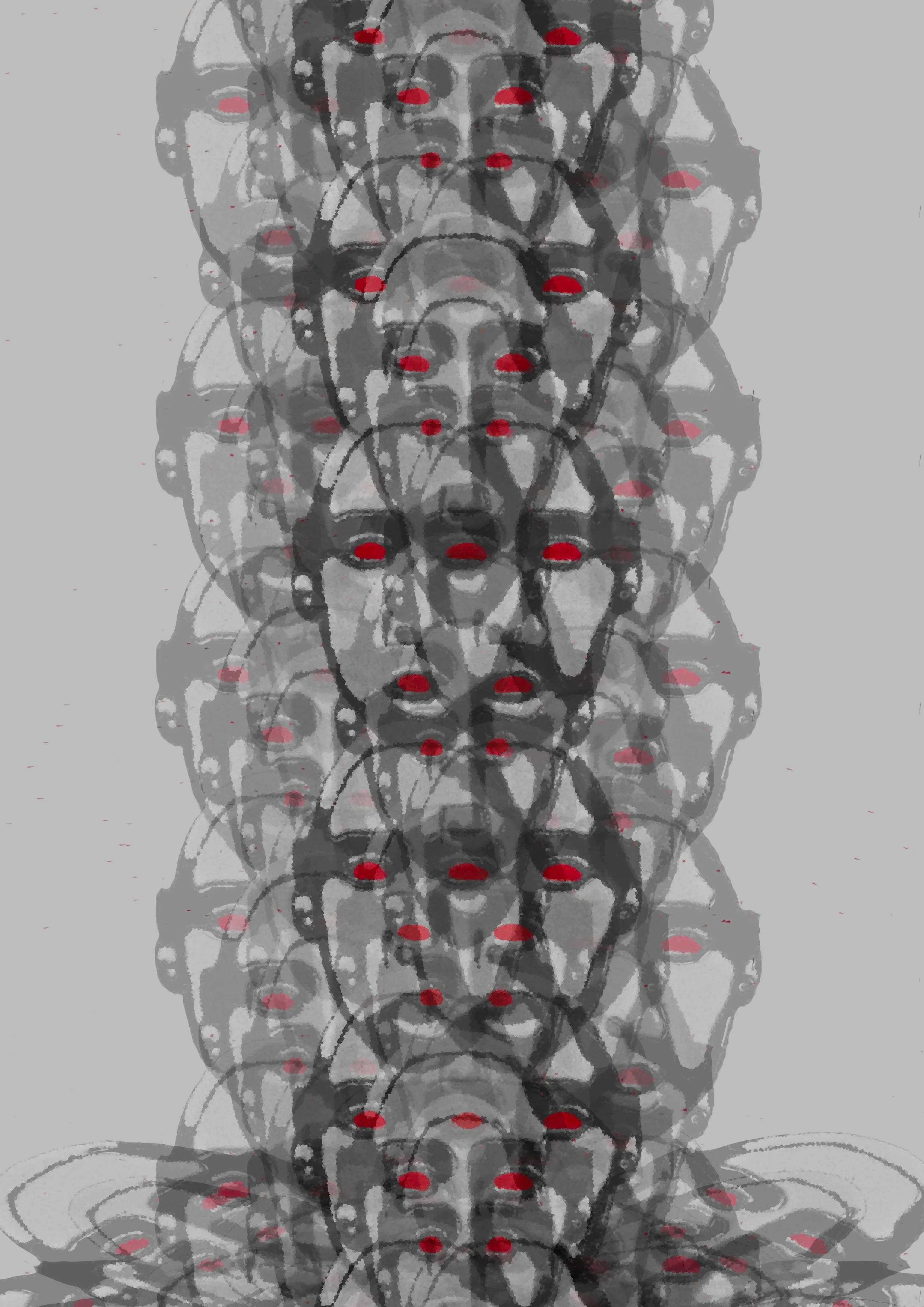
Virtù, 2026 Digital Print, A4
In Virtù (2026), Malik directly translates Machiavellian political pragmatism and Augustinian theology into a rigorous compositional challenge, dismantling the foundational assumptions of the western political canon. Rather than offering a traditional individualised portrait, the digital print presents a singular grayscale face that is mirrored, tessellated, and stacked into a towering vertical column. This structural reconfiguration draws its aesthetic impulse from the physical restraint of carved figures Malik observed at the Baltimore Museum of Art, where bodies are bound in cord and fibre to serve a purely structural capacity. By translating this textile logic into a digital print, Malik shifts the viewer’s gaze from the psychological interiority of the subject to the cold mechanisms of systemic architecture. The individual face disappears into a collective community of its own mirrored images, yet every pair of eyes remains hauntingly visible. Through this meticulous geometry, the artist removes the possibility of an exceptional observer, ensuring that no figure remains outside the pattern to judge the others.
It is within this tension between the individual and the pattern that the systemic trap of the work unfolds. In Malik’s visual universe, language is where the argument begins but the composition is where it stands to reveal its cost. For Augustine, the continuous nature of human sin necessitates an unending performance of repentance to uphold virtue. Malik materialises this conceptual burden by transforming the stacked faces into a heavy pillar, a form that exists precisely to bear collective grief and sustain the overarching frame. The historical weight of this structure is complicated by a subtle, unexpected gag effect that emerged through the digital layering process. Where the mirrored faces meet, the red eye shapes merge into what reads as a bound restriction, a visual subversion that introduces Machiavelli’s discourse on the performance of piety. A profound institutional paradox is thus exposed, as the performance of repentance promises cleansing but ultimately functions as a mechanism of constraint. The individuals are tragically trapped in a cycle of systemic bondage, made to hold up the very structure through which they seek release.
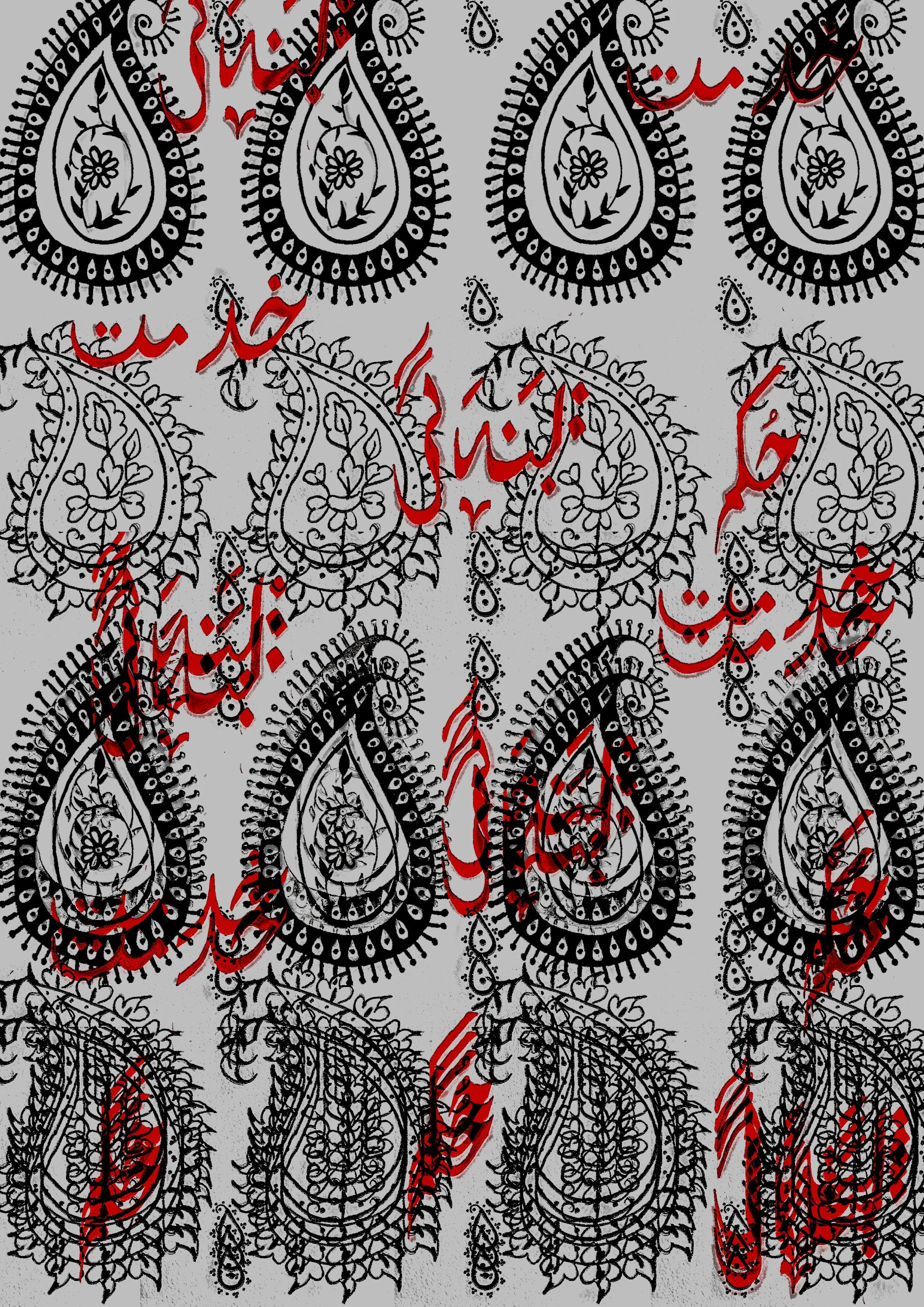
Object Permanence, 2026 Digital Print, A4
In Object Permanence (2026), Malik shifts her critical focus to the material world of production, challenging Aristotle’s idealized conception of leisure and spiritual flourishing. The digital composition establishes a stark visual friction between a field of black, Bagru-inspired botanical motifs and a series of fluid, red phrases hand-drawn in Nastaliq calligraphy. These words, which include bandagi, khidmat, and hukum, evoke a historic vocabulary of servitude, service, and command that underpins the rigid hierarchies of the South Asian domestic sphere. By introducing a script that is seldom encountered within the traditional western political canon, Malik actively resists the contemporary art market’s tendency to treat non-western text as mere superficial texture. The hand-drawn precision of the calligraphy forces the viewer to confront the historical specificities of the diaspora, subverting the globalized impulses that seek to flatten complex heritages into consumable commercial products.
The visual core of this conceptual argument resides in what Malik terms the bleed, the muddied areas where the aggressive red ink collides with the underlying black motif. For Malik, this blur is not an accidental blemish but an essential form of evidence, a material trace that records the exact moment human labour is transferred and claimed by power. Her perspective offers a sophisticated correction to the reductive binaries that often dominate post-colonial critique, as she carefully navigates between the limitations of trauma and resistance. To classify the work as a record of pure trauma is insufficient because the ink stain functions as an additive element that refuses to be erased. Conversely, to read it as triumphant resistance is overly optimistic because the mark does not recover the maker's name or dismantle the pattern. Instead, the composition embodies an aesthetics of persistence, a state where the system has successfully claimed the product and the credit, but the trace of the labour itself remains permanently embedded within the structure of the object.
By interrogating history through the lens of Adobe Photoshop, Malik fundamentally redefines the relationship between traditional archives and digital space. While a physical textile preserves the accumulated marks of time through frayed hems and faded dyes, a digital canvas possesses no inherent capacity for natural wear, meaning that every sign of damage within Malik’s compositions must be consciously introduced through the meticulous layering of digital masks. This conscious construction allows her to isolate and repeat specific conceptual marks, such as the accidental gag effect in Virtù or the constructed overlaps in Object Permanence, changing how history is encountered without falsely claiming to alter its reality. Ultimately, Malik’s research-led practice resists the instant legibility demanded by a western-centric contemporary art market, instead transforming her audience into what she terms finders. Her digital prints refuse to soften their culturally specific references for an uninitiated viewer, forcing a slower and more meditative form of attention. Through this uncompromising specificness, Malik establishes a critical space where the globalised homogenization of culture is met with quiet defiance, leaving a permanent structural echo that invites the viewer to look closer and discover the lingering traces of displacement for themselves.
In evaluating Malik’s practice, one must confront the profound tension that exists between her hyper-specific historical inquiries and the insatiable appetite of a globalised art market that frequently weaponises diversity as a mere decorative currency. The brilliance of her work lies not in its ability to be easily assimilated into the multicultural apparatus of Western institutions, but rather in its radical illegibility to the casual observer. By refusing to soften the complex lineages of Phulkari embroidery, Nastaliq calligraphy, or the geopolitical wounds of Balochistan, Malik deliberately constructs an entry barrier that frustrates the contemporary demand for instantaneous aesthetic consumption. Her digital prints perform a cruel and necessary trick, presenting an enticing, highly refined geometric surface that, upon closer inspection, entraps the viewer within the grid of systemic bondage and the unresolved history of displaced labour. Her critique does not offer a romanticised reconciliation with the past, nor does it deliver a marketable narrative of therapeutic healing. Instead, it leaves us with the unsettling reality of the trace, a structural persistence that forces the spectator out of the comfortable position of a passive consumer and into the rigorous, complicated role of a historical finder.
Artist Bio:
Esha Malik (b. London) is an emerging South Asian visual artist based in South London whose research-led practice interrogates the intricacies of cultural erasure and its manifestations within systemic structures. Anchored by her dual background in Politics and International Relations alongside her achievements as a published poet, Malik’s work navigates the fragile boundary between collective memory, inherited lineage, and historical displacement.
Her multidisciplinary approach seamlessly integrates archival research, digital photomontage, and traditional hand-drawn elements into meticulous, repetition-based compositions. Drawing aesthetic impulses from the Northern regions of Pakistan and India, Malik utilizes a distinct visual lexicon that synthesizes Phulkari embroidery, Rangoli geometric principles, Mughal architectural layout, and the structural motifs of 4th–5th century Hindu temples.
Through digital masking and textile-inspired logic, Malik deliberately manipulates these culturally specific motifs, flattening them into an abstracted, universal geometry. Rather than depicting absolute absence, her prints explore the "trace"—the lingering echo of a structure that persists after being worn down by displacement and historical repetition. Her practice ultimately serves as a critical inquiry into how inherited craft and cultural vernaculars resist, adapt, and endure against the homogenizing pressures of time and distance.
