
What, Then, Is the Role of Art Today?
Article by Camille Dressler
Exhibition Review
From the Heart of a Mother
Artist: Sana Obaid
Venue: Solas Eige Centre (formerly St Columba's Church), Isle of Eigg, Scotland
Dates: June 30–July 5, 2026
When I first met artist Sana Obaid in 2024, she was offering a workshop on how to make Dorodango (mud balls) to the community on the Isle of Eigg, as part of her VAS + Bothy residency on the island, sponsored by the Scottish Arts Council. It turned out to be quite a meditative practice which required patience and time to produce a perfectly round and shiny object out of the earth from my garden! As I enjoyed that little moment of quietness in my busy life, I felt I needed to know more about the artwork produced by this woman with a soft voice and seemingly limitless patience. When she showed me the sculptures and etchings she was working on in Glasgow, she also explained what had led to creating this body of work: she had been deeply affected by the grieving of a Palestinian mother, pressing to her face the clothes of her lost children, breathing in their scent, attempting to grasp that ultimate memory of them. Children’s garments treated via etchings, ceramics or impressions was how Sana was working to bear witness to this grief, the emptiness of the garments mirroring the feeling of loss.
Something clicked in my mind as Sana was recalling the experience that had led to create these artworks: this was art rooted in the reality of our daily lives and responding to what we were seeing on our screens in every news bulletin. Our island community was flying a Palestinian flag next to the Saltire to show its solidarity with the besieged people of Gaza, and we were discussing how we could support the Boycott, Divestment, Sanctions (BDS) movement in our local shops and businesses and daily lives, not such an easy task, but one that the community here was willing to try out. There seemed to be a synergy between our community and Sana’s practice that felt right, and how to bring Sana's work to our island became my goal.
A chance meeting with Maxwell Macleod at our mainland ferry terminal led to a successful application to the trust set up by his father for funds to bring Sana and her work to the Isle of Eigg. The founder of the Iona community, George MacLeod believed that places of worship should not offer escape from contemporary challenges, but rather provide spaces where people could reflect upon them, find meaning within them, and be inspired to respond. It was a perfect fit.
Meanwhile, the charity of which is I am a trustee - Solas Eige SCIO - was refining its business plan for submission to the Scottish Land Fund towards the acquisition of the Presbyterian St Columba’s Church on the island as a multi-purpose centre where artists could present their work and carry out winter residencies alongside island heritage and climate awareness activities. One of our trustees was also keen on keeping the space open for people on a spiritual quest despite moving away from its identity as a place of worship. When, in February 2026, our four-year effort to bring the church into community ownership finally succeeded, everything fell into place. Hosting Sana's work as the very first exhibition in the newly acquired building became more than an opportunity; it became the perfect way to mark its transformation.
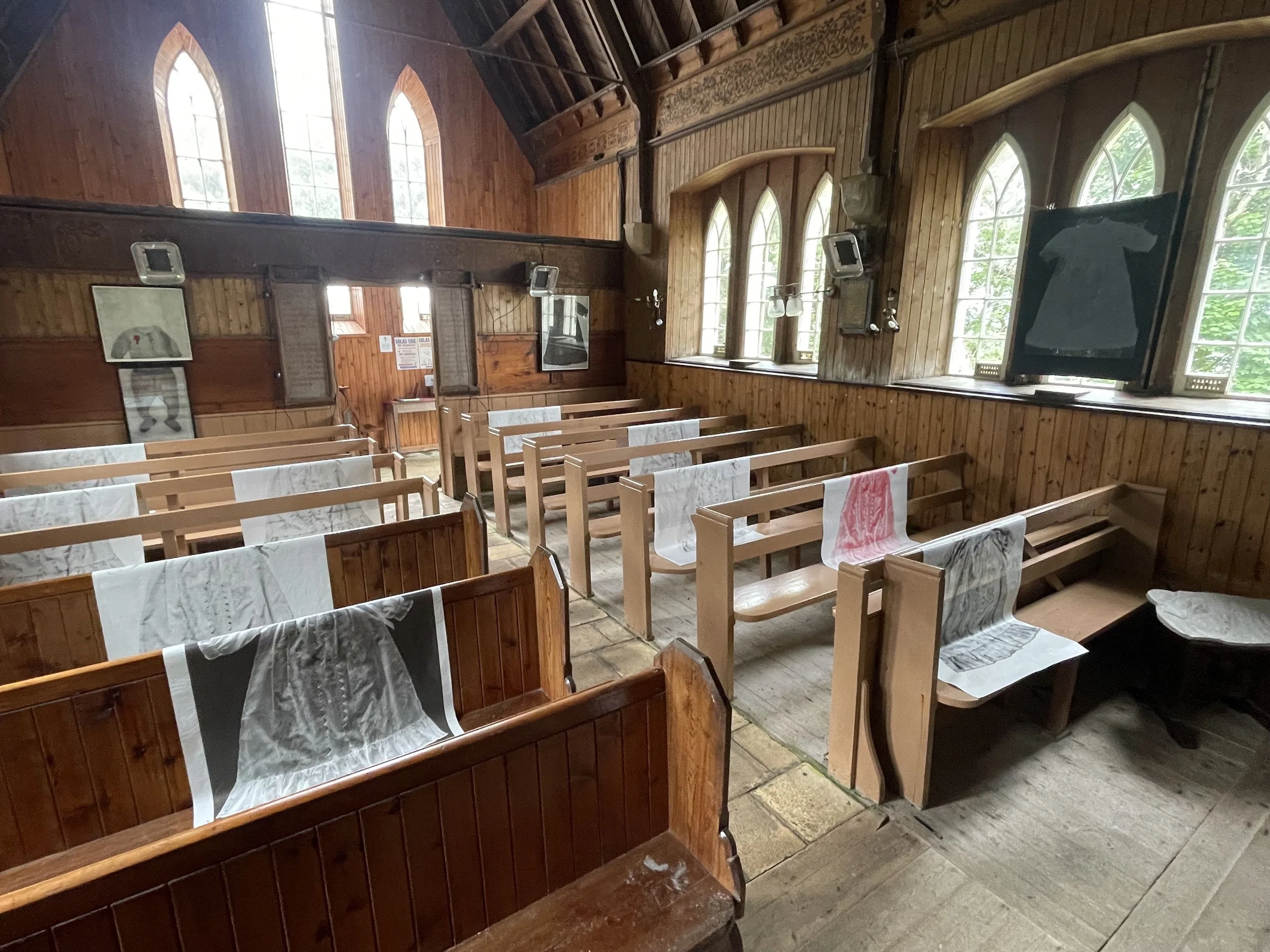
Installation view showing children's garment prints across the church pews.
Photograph © Sana Obaid. Courtesy of the artist.
Sana’s exhibition “From the Heart of a Mother” grew organically as she reflected on how to present her sculptures and etchings in a space still occupied by the pews and pulpit of a traditional protestant church. As the exhibition took over the space, I was struck by the precision and thoughtfulness of the way Sana placed the artwork. “The work has to speak for itself “ she said, and the pews were perfect for placing the prints of a child’s dress, making the absence of the bodies they related to even more poignant, filling the former church with the ghosts of child war victims. The ceramic sculptures were centre stage in front of the pulpit, lying on a heap of grey beach sand as random clothing would be in the rubble of a bombed building in Kive, Aleppo or Gaza. A polished printing plate with the imprint of a child's dress reflected our gaze, silently interrogating us. A dark print pricked with hundreds of holes around the shape of the garment allowed the light shed by the windows to filter through them. A cushion screen-printed with Palestinian embroidery and pierced by a thousand metal pins lay on a black cloth laid on the former communion table, in the stark evocation of a coffin. The red poppy wreath around the plaque still commemorating the fallen from WWI from last November was echoed by the red poppy Sana placed on the mounted prints of children's garments at the back of the building to be contemplated as one turned to leave. It all invited contemplative silence under the high wooden ceiling with its saltire trusses and stencilled tree of life motifs echoing ancient beliefs even older than Christianity, their stylised fig leaves copied from Iona medieval crosses.

Installation view of ‘Silence’Porcelain Installation, during the Exhibition From the Heart of a Mother, Solas Eige Centre (formerly St Columba's Church), Isle of Eigg, Scotland, 2026. Photograph © Sana Obaid. Courtesy of the artist.
The exhibition opening on 30 June provided the best opportunity to launch our vision of Ionad Solas Eige—the Solas Eige Centre—as a dedicated space for creativity, culture and community at the heart of the island. Solas Eige means "Light of Eigg" in Gaelic, and the idea of Eigg as a source of light already resonates far beyond the island. In creating the Solas Eige Centre, our hope was to extend that legacy—to become not only a beacon for environmental sustainability, but also a place where culture, creativity and community illuminate new ways of understanding ourselves and the world around us. It was entirely fitting that Sana's exhibition should be the first to illuminate this newly transformed space.
Calling into the Centre during the exhibition week, I was struck by the quiet presence Sana created as she sat with candlelight and incense. Without saying a word, she transformed the atmosphere of the space and invited a different way of engaging with the exhibition. Visitors, too, found themselves sitting in silence, lingering, reflecting. It felt as though the spiritual dimension our founding trustee, Karen, had always hoped the Centre might nurture was beginning to take shape.
What unfolded was more than a moment of quiet contemplation. It offered people the rare opportunity to step outside the rhythm of everyday life, to sit with their thoughts, and to connect with events far beyond our small island. In that shared silence, the exhibition became a place of empathy and witnessa reminder of our common humanity and of the invisible threads that bind our lives to those of others. Experiencing this was profoundly reassuring. rather than look away. It affirmed that the vision of the Solas Eige trustees was not merely aspirational but deeply rooted in the lived experience of those who entered the space.
What, then, is the role of art today?
For me, "From the Heart of a Mother" offered one answer. It reminded me that art is not only something to be looked at, but something that can gather people, awaken empathy, encourage reflection and strengthen the social fabric of a community. In an age when we are exposed daily to images of war, displacement and injustice, it is all too easy to become overwhelmed or emotionally numb. Art can interrupt that numbness. It creates spaces where we stop, reflect together and remember our shared humanity. I am now more convinced than ever that communities need dedicated space where art invites us to confront the realities of our world rather than look away. Such spaces are not a luxury; they are essential.
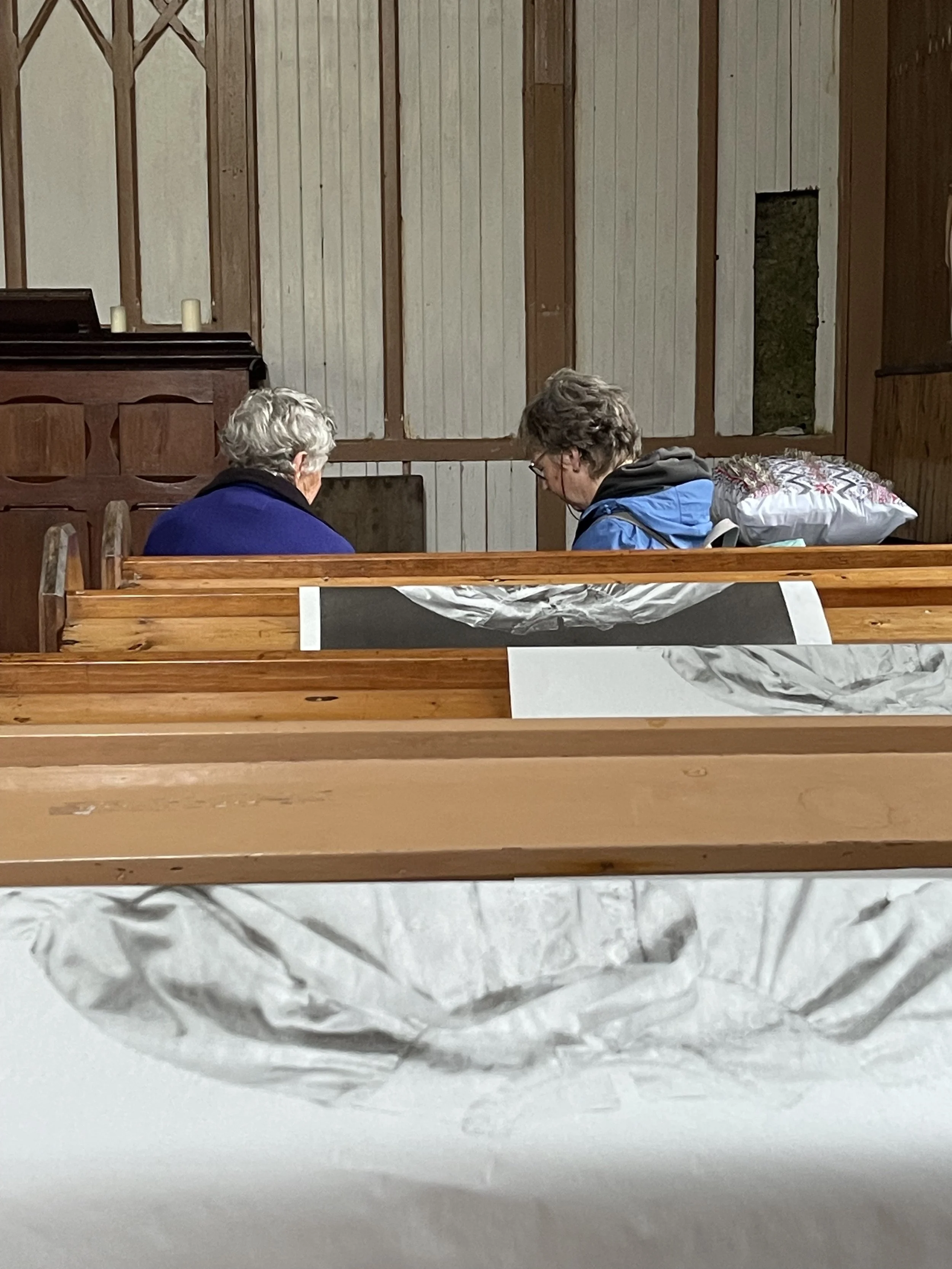
Visitors in quiet contemplation during the exhibition.
Photograph © Sana Obaid.
An integral part of the exhibition was also for Sana to hold adult and children collagraph printing workshops in the marquee erected by St Columba’s. Sana worked equally well with adults and children, and it was remarkable how much concentration the Eigg children were able to hold on to as they produced colourful prints of leaves and plants growing around the building. When they later visited the exhibition with Sana, their responses revealed an instinctive empathy for the work. One child quietly observed, "It feels like they are hurt," while another simply said, "I am feeling sad." Their words required no interpretation; they had already understood the emotional language of the exhibition.
I was really looking forward to taking part in the adult workshop as art making is part of my own practice to balance my life, so largely dedicated to project working on a computer screen! First, we visited the exhibition again as a group of nine women and listened as Sana talked about the divine feminine and her own spiritual practice inspired by her family’s Sufi background. When do you get to chat about such matters in your daily life?
Then through the workshop, we explored how texture and colour can become a language of their own, creating images that speak to us—and sometimes speak for us—when words are not enough. As part of my own collagraph making, I was able to use the poignant image of a Syrian woman holding her child with such an anguished look on her face that it moved me to pin it to my wall for International Women’s Day that year as a permanent reminder of what I did not know yet how to call “From the heart of a mother”.
This is what I love about art, the way Sana makes it. It’s not just an intellectual process; it’s an emotional and spiritual process which, in turn, provokes in the viewer and the workshop participant a similar process, taking them out of the everyday into a place where deep emotion can well up and express itself. We need this badly: our lives are consumed by actions and reactions, and we rarely stop to consider.
But “From the Heart of a Mother” made us stop and consider. It allowed us to feel that heartbeat of the mother which is in all of us as human beings, and for a short moment to connect on a universal level. There is a school of thought that holds that connecting to the universal heart pulse affects the global quantum field positively. With Sana Obaid, I feel we might have just done that.
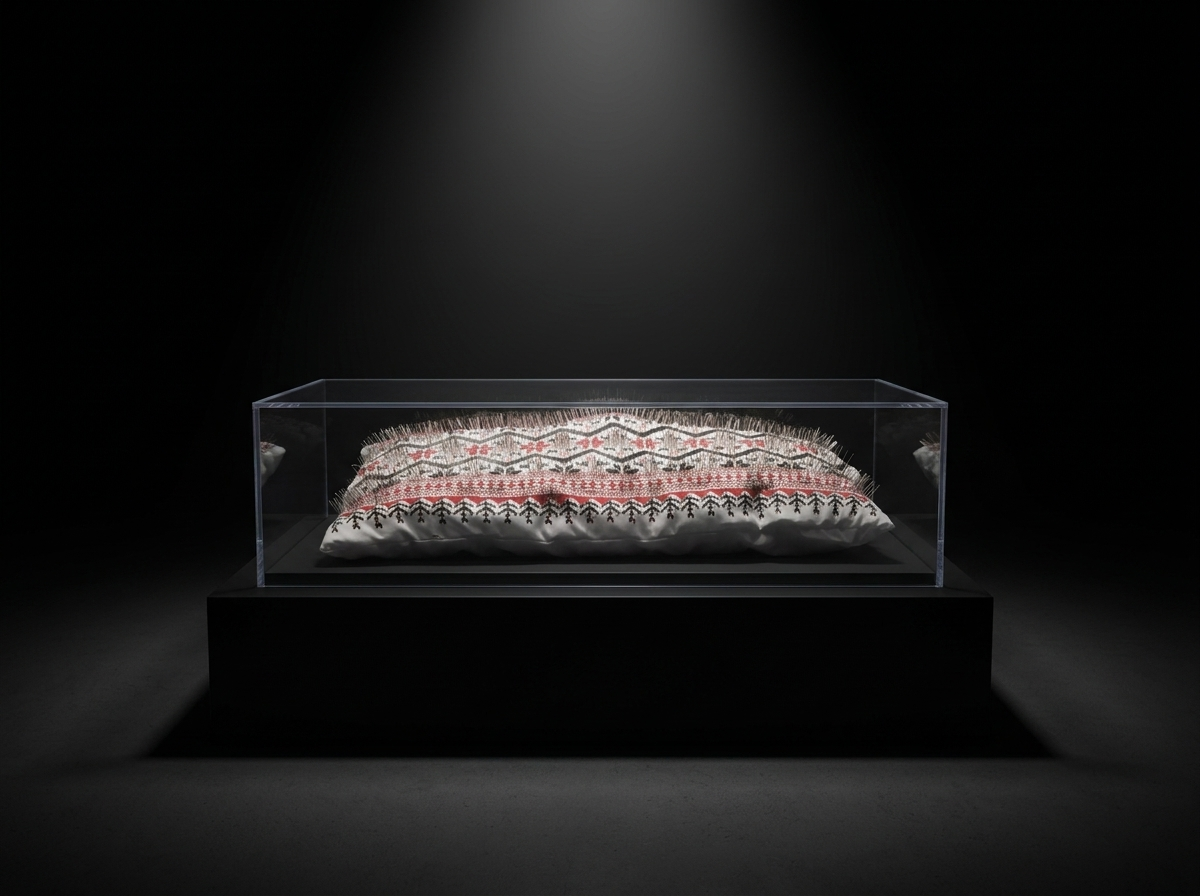
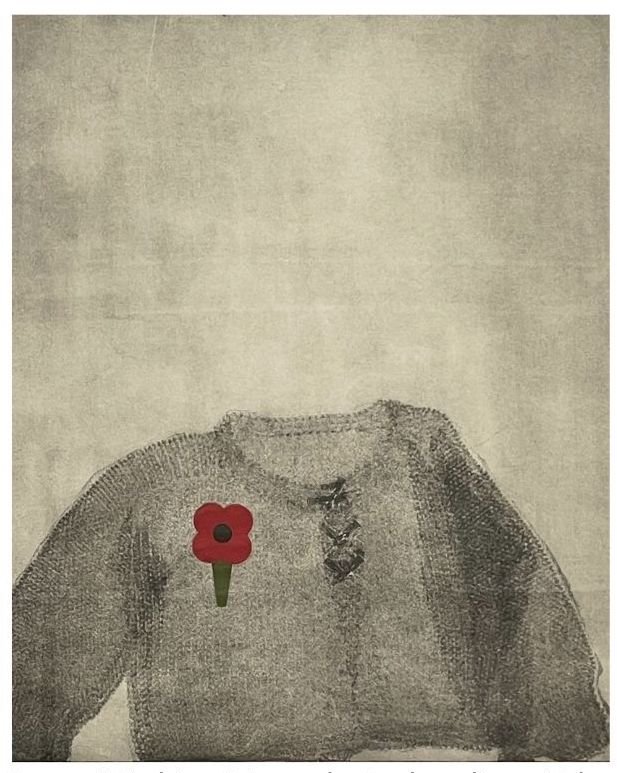
(Left image) A Pillow, 2025. Screen-printed Palestinian embroidery motif on burial shroud, pillow, and hundreds of steel needles.
(Right image) ‘Poppy I’,Printmaking, Etching and Collage on hahnemuhle paper, 2026. Photograph © Malcolm Hutcheson. Courtesy of the artist.
Author Biography
Camille Dressler is a writer, historian, and environmental educator based on the Isle of Eigg, Scotland. She is a trustee of Solas Eige SCIO, Director of the Scottish Islands Federation, and Vice-Chair of the European Small Islands Federation (ESIN). She is the author of Eigg: The Story of an Island, an acclaimed history of the Inner Hebridean island that draws on oral traditions, archival research, and local song to document its journey from clan society and the Highland Clearances to the landmark 1997 community buyout. Her writing explores the intersections of contemporary art, community, cultural heritage, environmental stewardship, and island life.