
EXHIBITION - Residual: What Never Stays
A Post-Exhibition Reflection
During London Design Festival 2026, Residual: What Never Stays occupied Calder Contemporary in central London. Presented by LILIS LAB and curated by Jiayin Lu, the exhibition brought photography, sculpture, ceramics, moving image, textiles and installation into one space, beginning with something much less polished: the temporary support structures generated alongside a 3D print.
In 3D printing, supports are temporary by design. They hold difficult geometries in place, making forms possible that could not otherwise be printed. LILIS LAB encountered this logic repeatedly in its own production practice, not only through supports, but through prototypes, failed prints and temporary solutions that disappear once the final object is complete. Once their role is fulfilled, what was once necessary becomes excess.
That contradiction became the starting point for Residual, leading to a broader question: can a finished object ever really be separated from everything that made it possible?
Donna Haraway’s idea of sympoiesis, or “making-with”, became one way of thinking through this question. Things do not emerge independently. They take shape through relationships between materials, technologies, bodies and environments.
From there, Residual moved beyond fabrication. Residue became less about waste and more about what continues: something held in the body, carried through memory, marked by absence, altered through transformation, or left behind by a process that has already moved on.
Inside Calder Contemporary
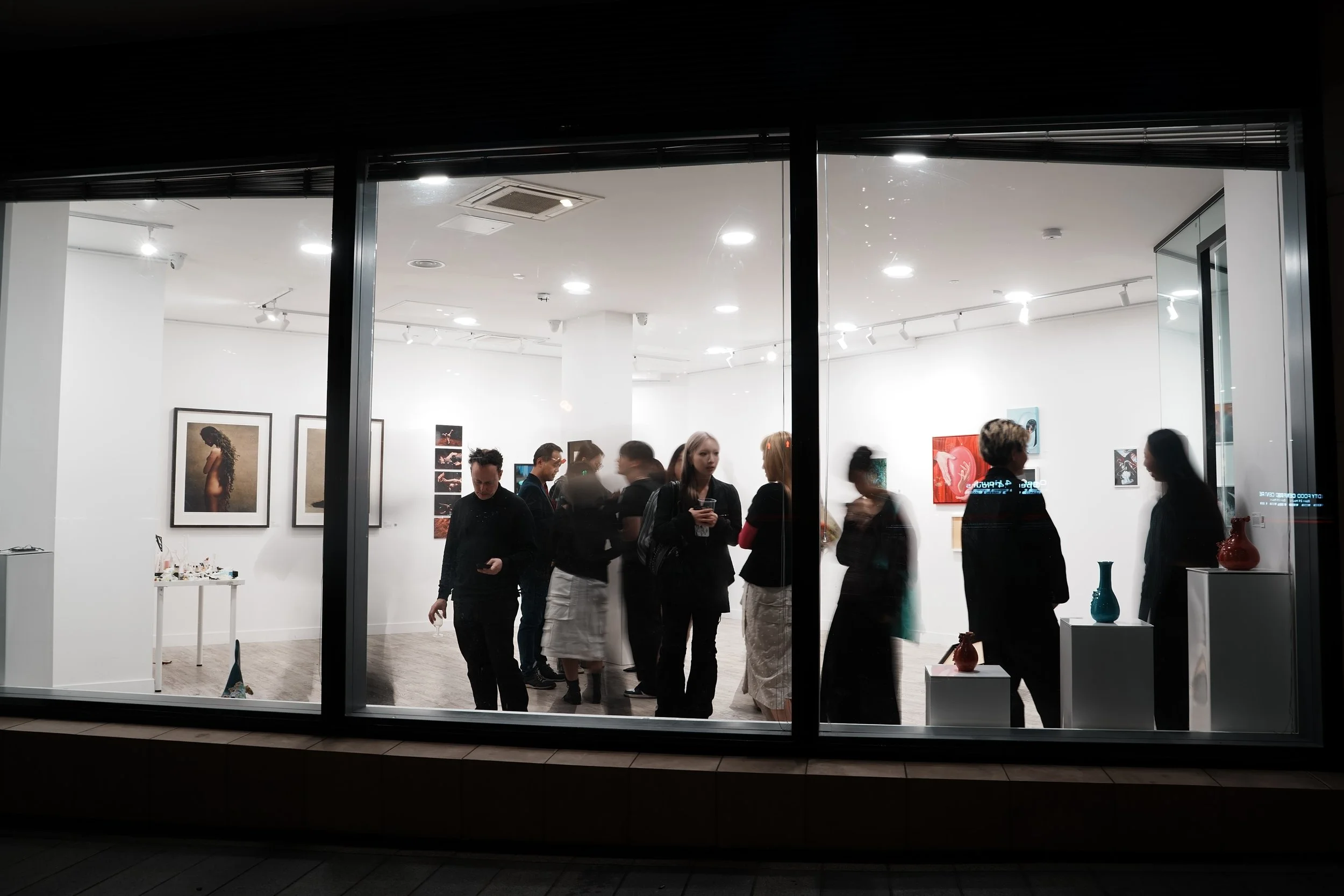
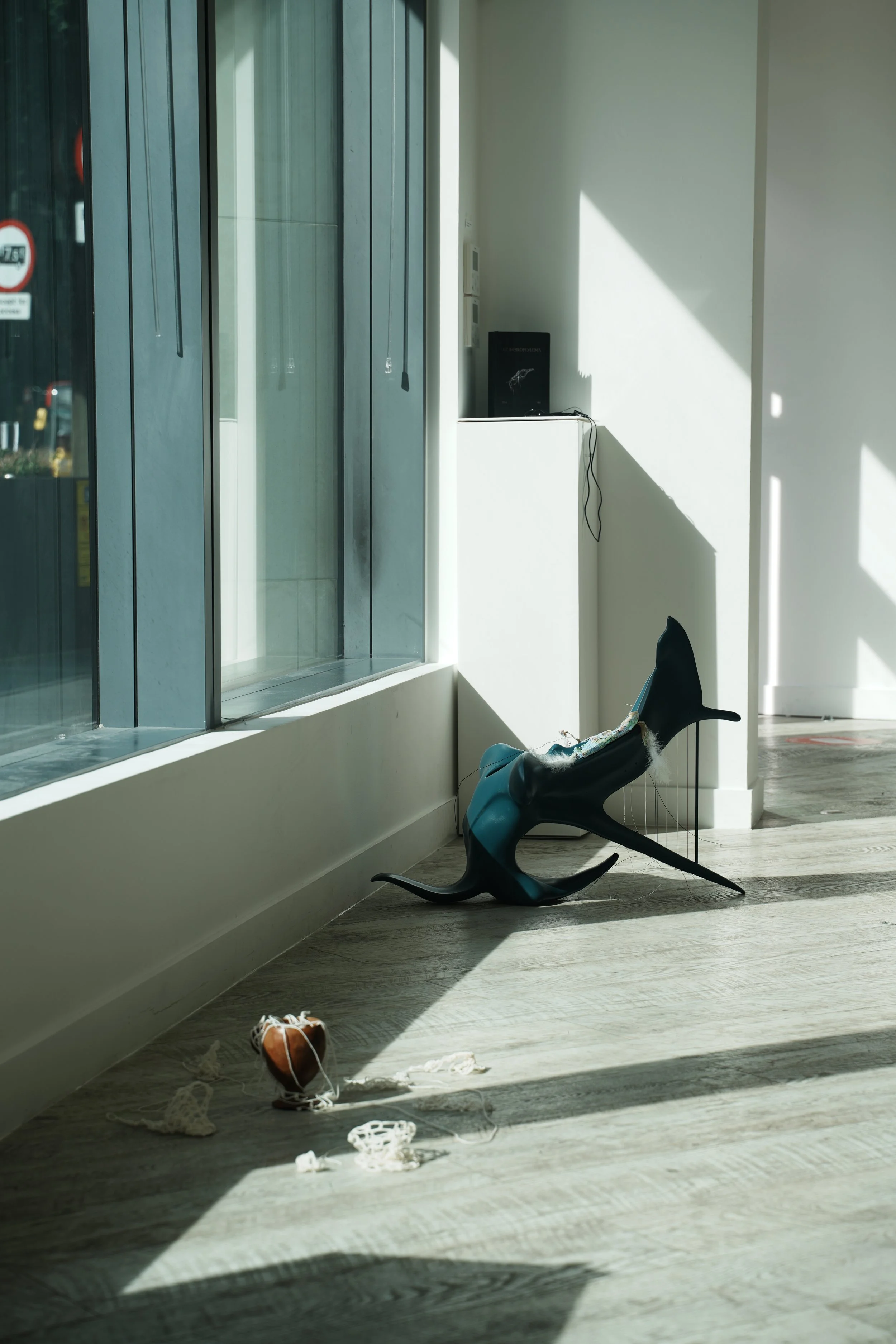
Through Calder Contemporary’s floor-to-ceiling windows, Residual was visible before visitors even entered the gallery. The exhibition brought what is usually discarded, hidden or overlooked directly into view. Against the polished surfaces outside, the show turned attention towards what sits beneath the finished surface.
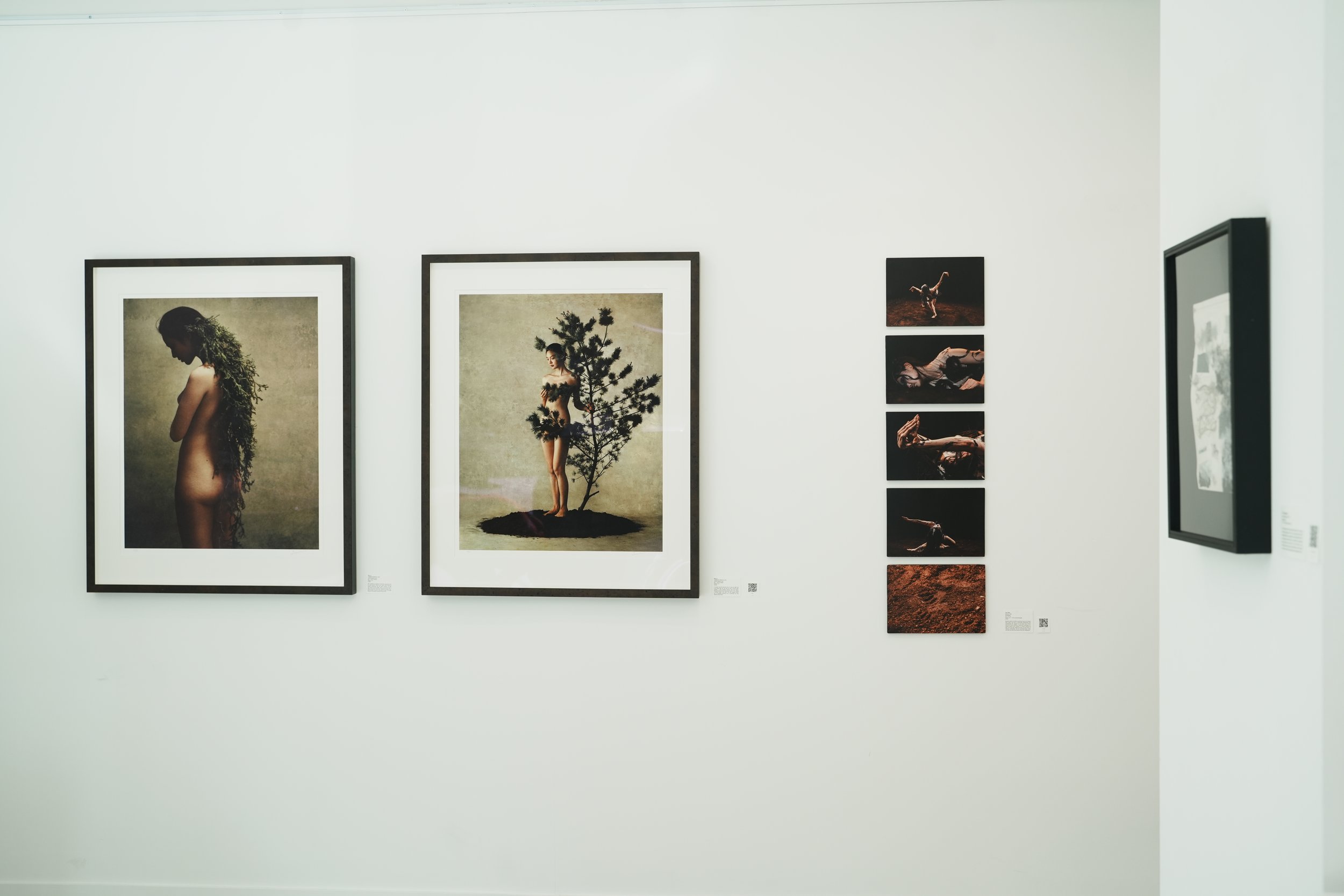
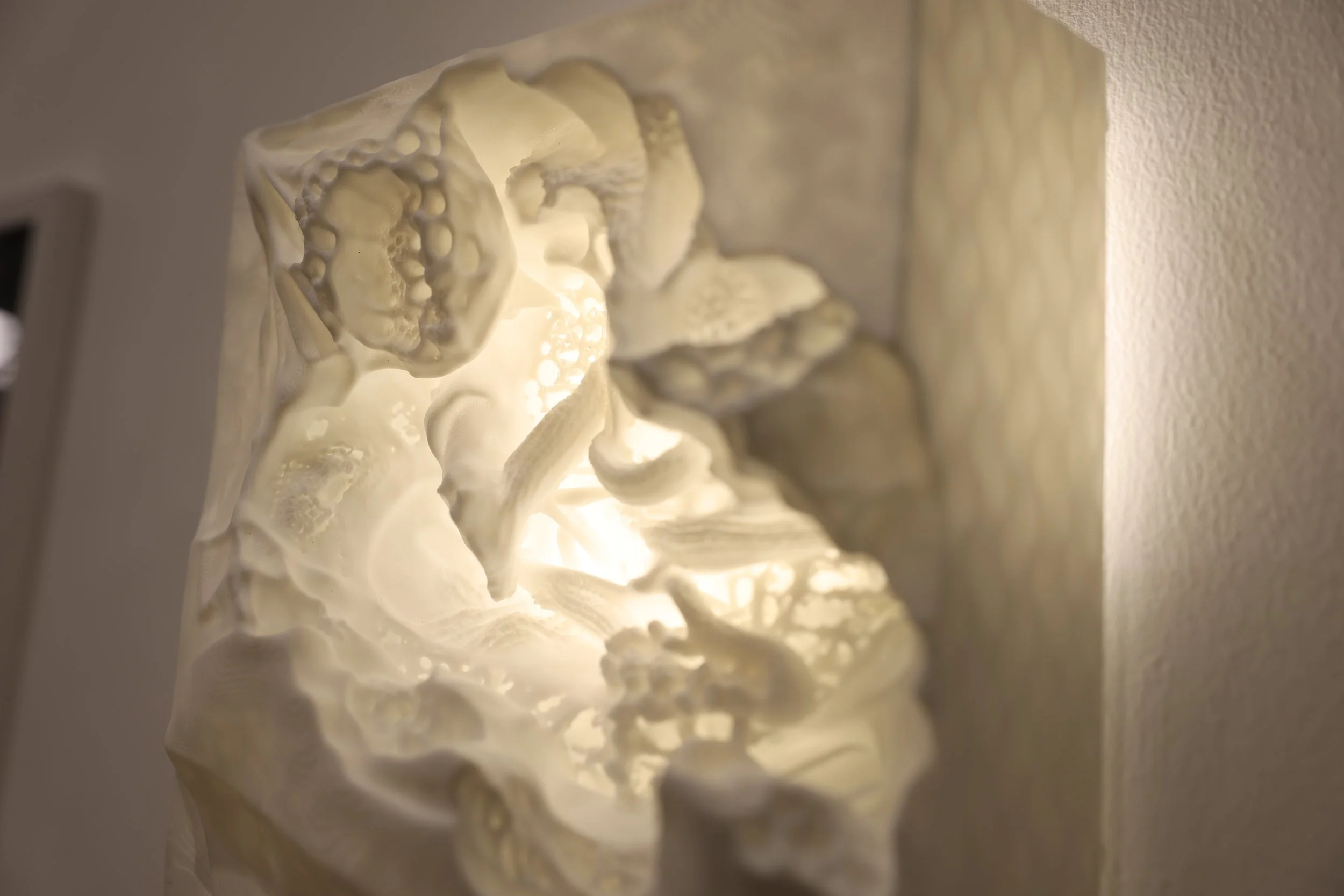
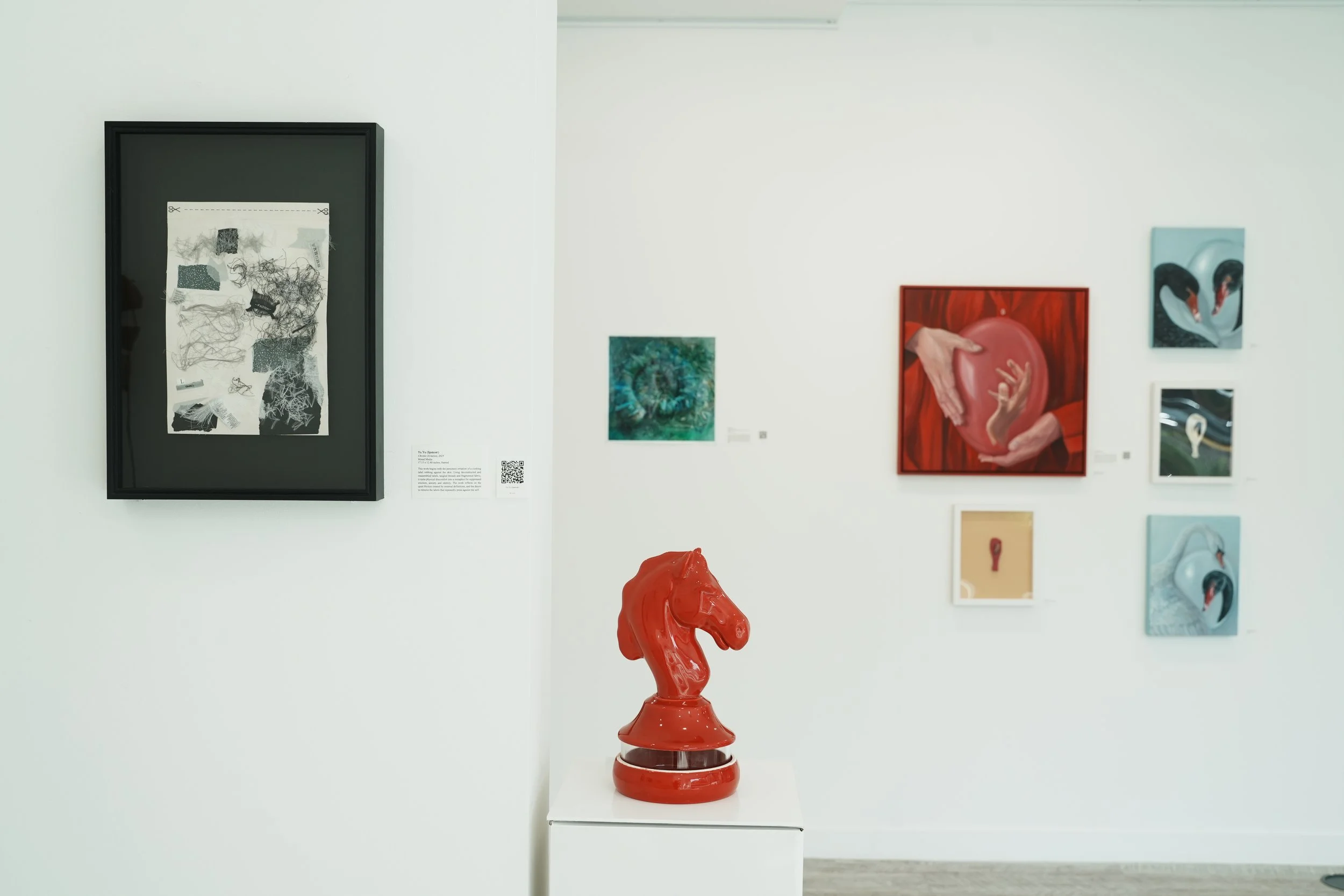
Photography, moving image and physical objects often overlapped within the same view. Soft and translucent materials sat against harder fabricated structures. Across the space, different materials and forms carried their own sense of residue, from physical traces and shifting structures to memory, bodily experience and imagined histories.
Across these different practices, recurring states of transition began to emerge: presence and disappearance, completion and incompletion, use and redundancy. Residue became less a leftover than a way of thinking about what persists after something has changed, disappeared or moved on.
Giving the Support Another Life
At the centre of the participatory installation was an empty frame without glass. A frame usually marks the boundary of a finished work, separating it from the viewer and fixing what belongs inside. Here, that boundary was deliberately left open.
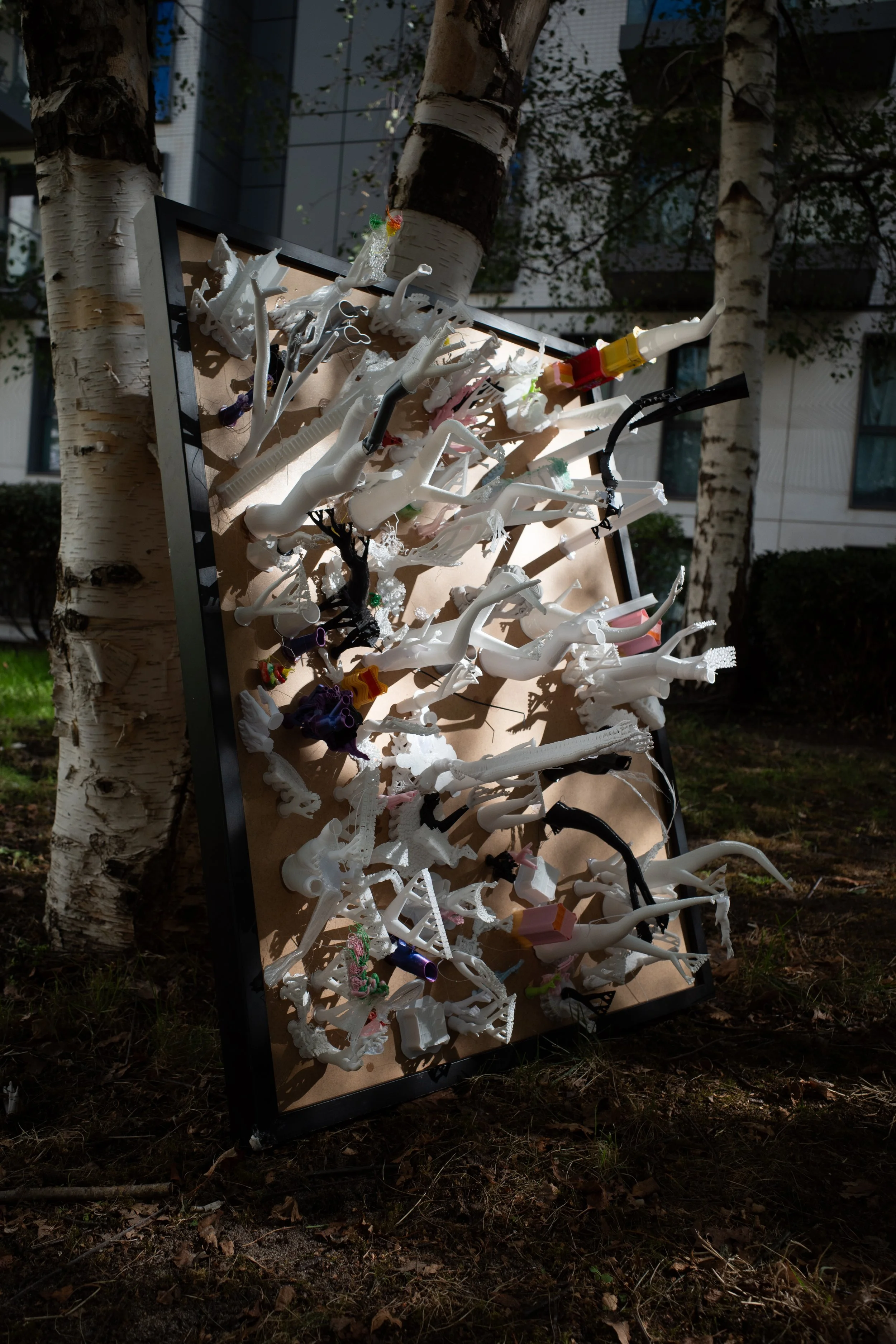
Discarded 3D-printing supports were placed beside the frame, and visitors were invited to attach them directly onto it. There was no fixed composition or final image to reproduce. Each contribution altered what the next person encountered.
Once their technical function was over, the supports entered a new process of making.
Fragments were turned, rearranged, and connected to forms they had never originally belonged to. Their meaning no longer came from the objects they had once supported, but from the new relationships they formed with one another and with the people handling them.
By the end of the exhibition, the structure belonged to no single author. It had accumulated through different hands, decisions and encounters.
Here, “making-with” was no longer simply an idea. It became something enacted in the room.
What Remains
Looking back at Residual now that the exhibition has closed adds another layer to the project.
An exhibition is temporary too. Works are brought together, positioned in relation to one another and experienced for a limited period. Then the installation comes down, and that particular arrangement disappears.
What remains is never complete: photographs, documentation, conversations, memories, materials and relationships continue elsewhere.
For LILIS LAB, this brings the exhibition back to where it began: the 3D-printing support. Creative work is usually encountered through finished outcomes, while much of what makes those outcomes possible remains unseen.
Residual briefly redirected attention towards those less visible conditions.
What began with discarded supports ultimately became a wider question of value: what do we choose to keep, what do we overlook, and what continues to matter after its original role has ended?
When the gallery was emptied, the exhibition itself entered that same condition.
It no longer existed as one complete arrangement.
What remained were its traces.
Participating artists: Yu Yu (Spencer), Wei Lu, Angel Pan, Manisha Puri, Ziyo Li, Dimension Ceramic (Di Meng), Xinyue Hope Shen, Jeff and Siena Wang, Yun Wen, Tongxin Lu, Bingxu Qiang, Tatiana Fetisova, Shaw Liu, Jill Yao, Jiabao Zhao, Jiayin Lu and Wan'er Li.
Residual: What Never Stays
Presented by LILIS LAB
Curated by Jiayin Lu
19–21 September 2026
Calder Contemporary, London
Part of London Design Festival 2026
Photographer: Leo Qiang, Shaw Liu, Xutong Ye, Jiayin Lu
LILIS LAB
LILIS LAB is a London-based creative studio working across contemporary art, design, and digital fabrication.
We support artists, designers, brands, and creative practitioners in bringing ideas into physical form through design, prototyping, production, and visual presentation. Alongside our fabrication practice, we curate exhibitions and collaborative projects exploring the intersections of art, design, making, and technology.
Through exhibitions, Open Calls, artist support, and our Artist Platform, we create opportunities for collaboration, experimentation, and public engagement while building an international network of creative practitioners.
