
Issue 3: The Hierarchies of Power in Contemporary Art
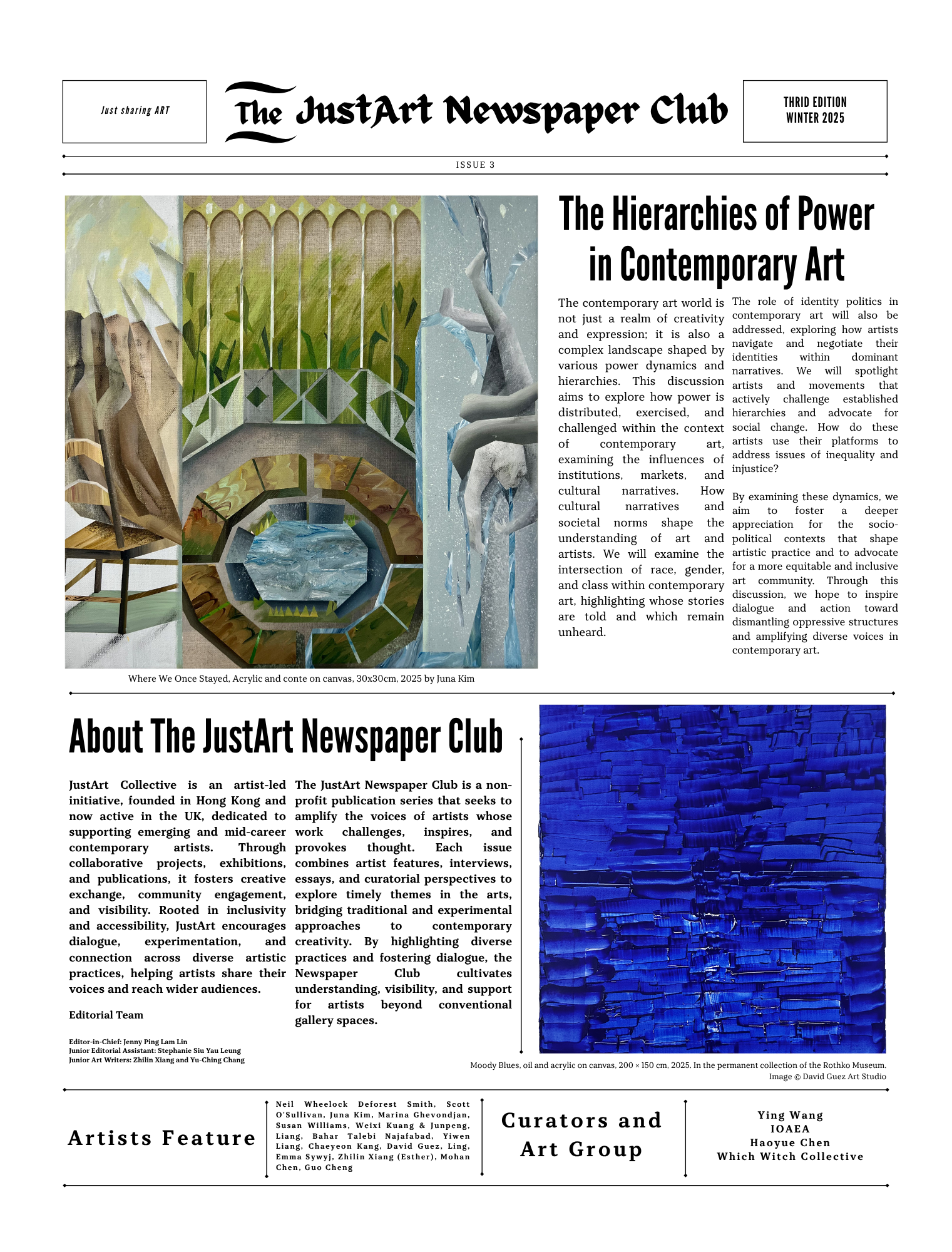
2025.12.02
Editorial Team
Editor-in-Chief: Jenny Ping Lam Lin
Junior Editorial Assistant: Stephanie Siu Yau Leung
Junior Art Writers: Zhilin Xiang and Yu-Ching Chang
32 pages
Cover Artists:
Juna Kim and David Guez
Artists list:
Neil Wheelock Deforest Smith
Scott O'Sullivan
Juna Kim
Marina Ghevondjan
Susan Williams
Weixi Kuang & Junpeng Liang
Bahar Talebi Najafabadi
Yiwen Liang
Chaeyeon Kang
David Guez
Ling
Emma Sywyj
Zhilin Xiang (Esther)
Mohan Chen
Guo Cheng
Writer, Art group, curator:
Ying Wang
IOAEA
Haoyue Chen
Which Witch Collective
JustArt Newspaper Club can be purchased online through this Google Form. After filling out the form, our staff will notify you via email.
The contemporary art world is not just a realm of creativity and expression; it is also a complex landscape shaped by various power dynamics and hierarchies. This discussion aims to explore how power is distributed, exercised, and challenged within the context of contemporary art, examining the influences of institutions, markets, and cultural narratives. How cultural narratives and societal norms shape the understanding of art and artists. We will examine the intersection of race, gender, and class within contemporary art, highlighting whose stories are told and which remain unheard.
The role of identity politics in contemporary art will also be addressed, exploring how artists navigate and negotiate their identities within dominant narratives. We will spotlight artists and movements that actively challenge established hierarchies and advocate for social change. How do these artists use their platforms to address issues of inequality and injustice?
By examining these dynamics, we aim to foster a deeper appreciation for the socio-political contexts that shape artistic practice and to advocate for a more equitable and inclusive art community. Through this discussion, we hope to inspire dialogue and action toward dismantling oppressive structures and amplifying diverse voices in contemporary art.