
Layers of Stone and Time: The Slow Art of Qinglai Tom
Born in 1991 and based between Guangzhou and Zhuhai, Qinglai Tom is a contemporary mineral painter whose practice bridges traditional material techniques and contemporary conceptual concerns. Originally trained in Advertising and Branding at Beijing Normal University, she later studied under prominent mineral painting practitioners including Lian Yang, Xu Zhuomin and Zhu Jin, developing a practice grounded in the revival of Chinese mineral art. Recent exhibitions include the group exhibition Trio: Dialogue Between Form and Colour at Sol de Paris in 2025 and the thematic exhibition Meeting You at LooLooLook Gallery in Paris in 2026, alongside her solo exhibition Material Topology in Zhuhai. Working with natural mineral pigments, Tom explores the intersections of locality, memory and selfhood, using an ancient medium to reflect on contemporary experiences of identity and time.
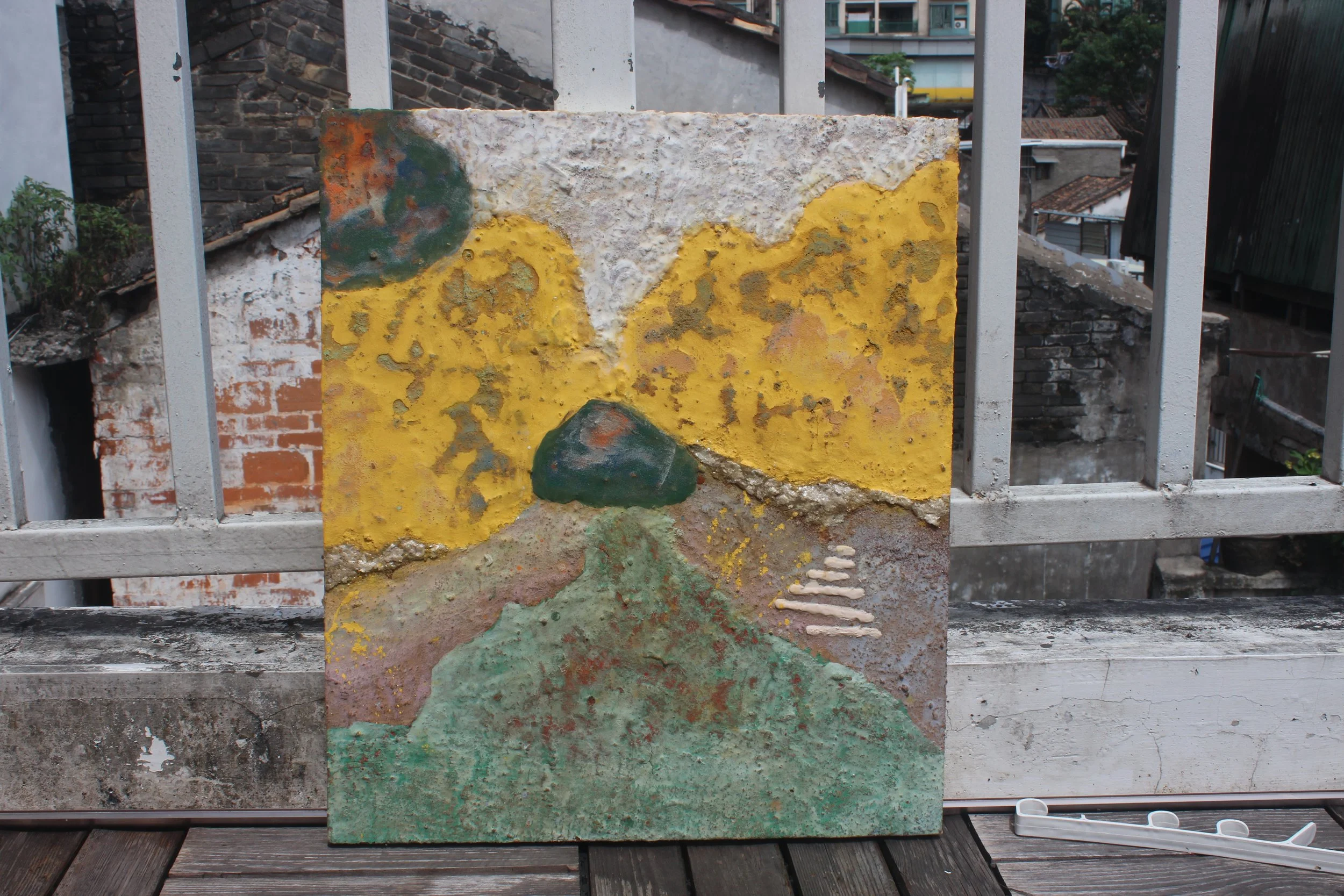
This material resistance is anchored in her 2025 landscape series, 《南方,南方》(South, South), which uses a geological foundation to ground regional memory within the landscape. While the series seeks to disrupt the decorative nature of traditional Chinese mineral art, it simultaneously acts as an early repository for geographical memory. In works like 《溪头》 (Xituo Village), the humidity, memories, and wildness of southern China are not conveyed through smooth, polished brushwork, but through a deliberate, tactile friction. Layering over twenty raw minerals over an earthen underpainting; including Malachite (孔雀石), South African Red Jasper (南非红碧玉), Realgar (雄黄), and Sugilite (舒俱来), Tom turns the
canvas into a site of geological memory that is rough and physical. The colour strategy here relies on intense, opaque saturations; the deep greens, earthy tones and muddy undertones are not passive stains but accumulations of mineral matter that catch light through their raw grain. By intentionally trading the hyper-refined look, which Tom critiques as an "exquisite handicraft", for this intense texture, she expands the expressive possibilities of mineral painting. The grit stops being just a visual trick and becomes a heavy, physical record of the untamed and humid reality of the southern China landscape. Ultimately, the work positions material density as a counterpoint to the speed and visual flattening associated with digital image culture.
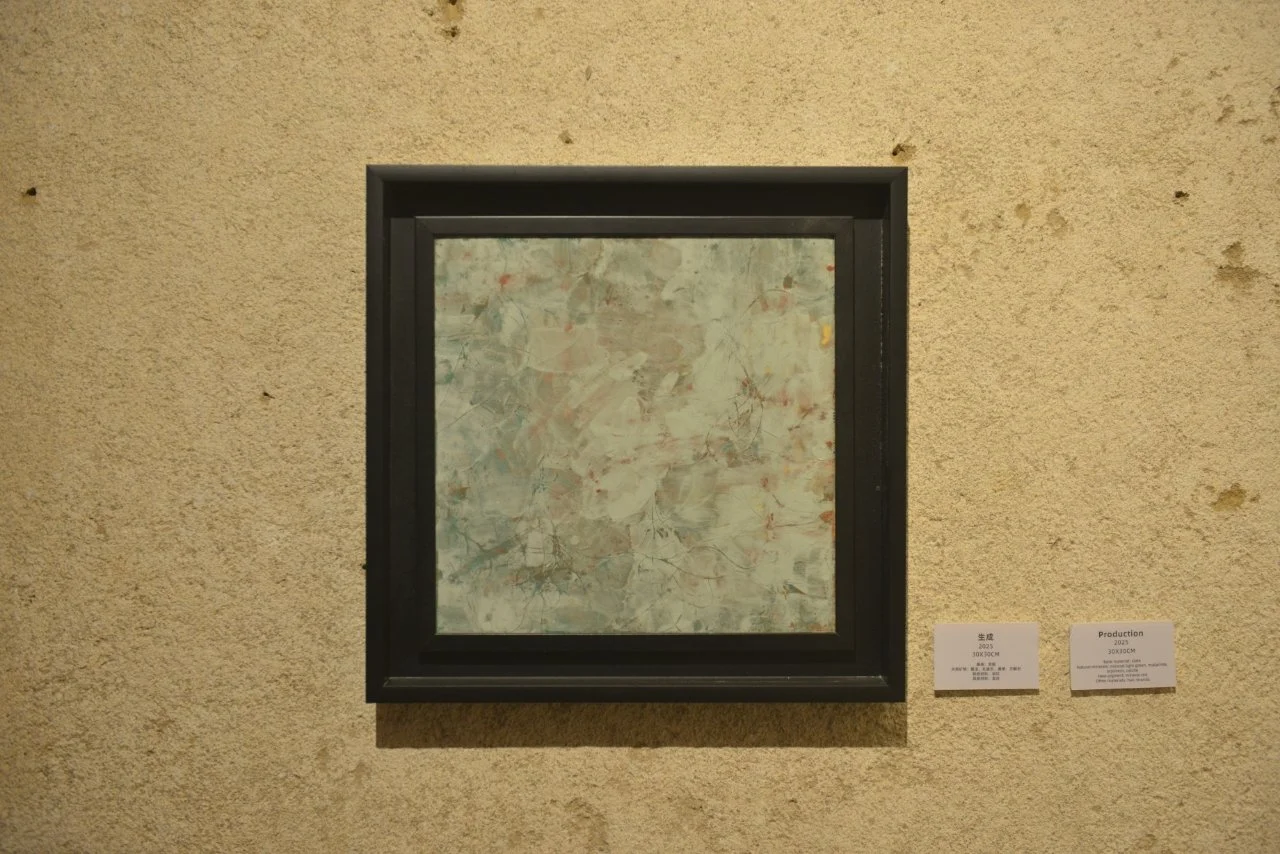
As her practice progressed through 2025, this dialogue with material agency shifted from regional geography into an intentional surrender of absolute artistic control. This shift was exemplified by the conceptual bridge work 《生成》 (Generation), completed in August 2025. Moving away from traditional paper substrates, Tom utilises a compact, 30x30cm rigid mud board and introduces a biological yet intimate intervention: strands of her own hair woven directly into natural minerals including Jasper (碧玉), Malachite (石绿), Orpiment (雌黄), Calcite (方解石), and synthetic mineral pigments like Yanhong (岩红). Chromatically, the work thrives on the tension between the raw neutrality of the mud base and the sudden, piercing veins of reds and greens. By embedding her own physical remnants into the wet mud, she immerses herself in a literal form while surrendering absolute painterly authorship. The hair creates unpredictable linear paths that slice through the colour blocks, actualising her philosophy that the mineral and the artist are mutual authors of the image, turning her work into a manifestation of the fusion of her current biological self and the ancient medium.
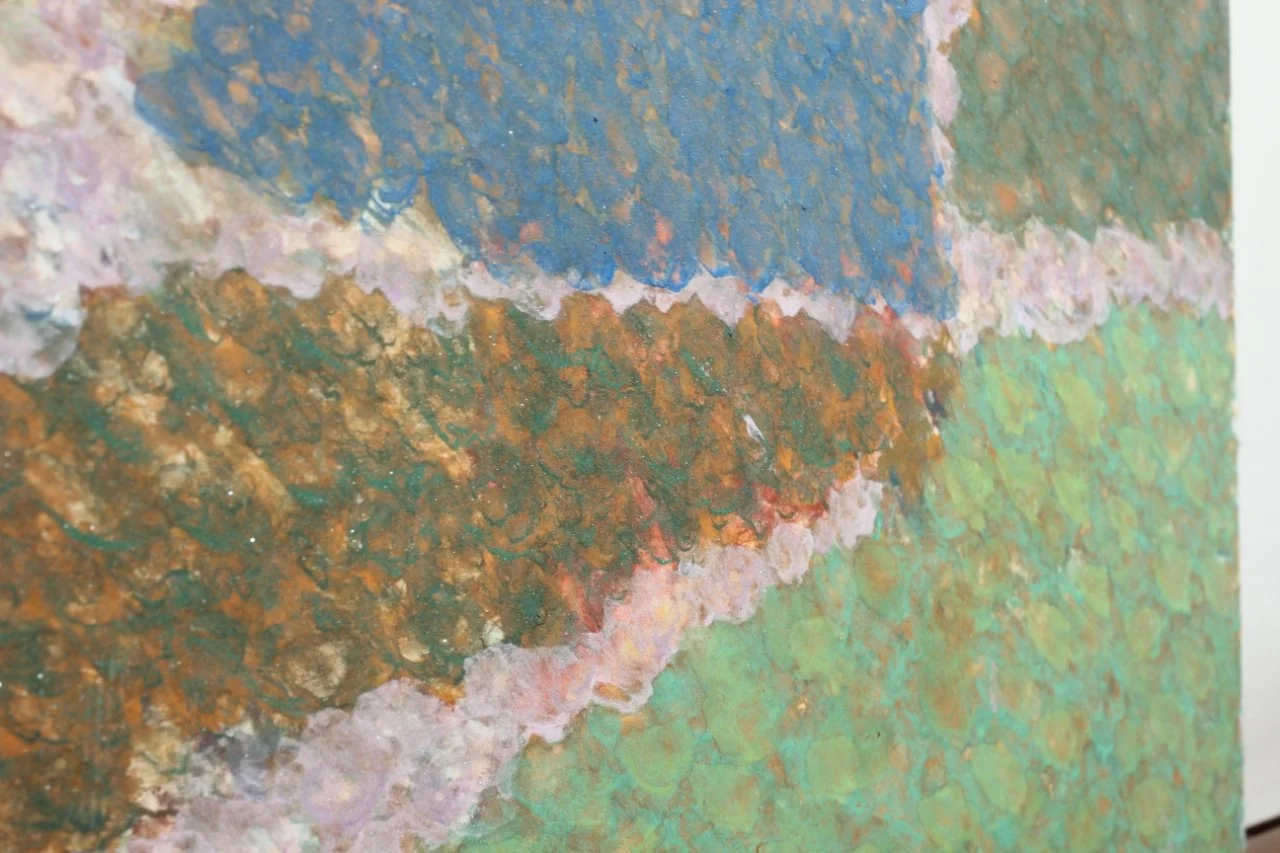
By 2026, this structural framework underwent an intimate shift, from the macro-environment to what Tom calls a "personal matter" of internal memory. This psychological turning point is fully realised in her approach of incorporating the shared histories of her mother and grandmother. In her recent canvas, 《祠堂菜地》 (Ancestral Hall Vegetable Garden), the heavy, raw textures of her medium are re-contextualised to serve a softer, deeply personal purpose. Tom utilises a diverse mineral palette, including Ruby dust (红宝石末), Sugilite (舒 俱来), Cinnabar (朱砂), and Clam Shell Powder (蛤粉), over Yunchuan hemp paper to build the domestic imagery. While the surface retains a thick, opaque impasto, the colour strategy shifts into vibrant, childlike pastels. By blending these heavy minerals with a chalky ground, Tom transforms geological density into a gentle, fading language of memory. The material becomes unexpectedly tender, registering the fragile, fleeting nature of childhood memory. Ultimately, these luminous pastel tones soften the canvas, capturing a private, dreamlike history of the family garden.
What makes Tom's work particularly relevant today is the medium she has chosen to work with. As an ancient material practice, mineral painting occupies a rare position within contemporary visual culture. Built from minerals formed over the course of Earth's history, its physical substance carries an inherent geological significance. This becomes especially striking within a contemporary image culture where digital and AI-generated images circulate rapidly, and visual experience is increasingly shaped by immediacy, repetition and consumption. This renewed interest in mineral painting as a contemporary expressive language can also be seen in the work of Hong Kong artist Chung Tai-fu, although Tom approaches the medium through a distinctly autobiographical lens. In contrast to the flat screen, mineral painting unfolds through an entirely different logic: pigments must be layered gradually, each layer requiring time to dry naturally before the next can be applied. The image is not produced instantly but accumulates slowly, almost as if it is being excavated rather than made. In this sense, the slow procedural time of mineral painting operates as a form of temporal resistance within a culture defined by acceleration.
Ultimately, Tom’s practice is shaped by the contrast between Guangzhou’s restless momentum and Zhuhai’s slower rhythm. That tension runs through her paintings, which remain rooted in personal memory while staying open to projection, creating a space for viewers to reflect on their own histories and attachments. At a time when images are increasingly produced and consumed at speed, Tom’s mineral paintings offer something different: a slower way of looking, where layers of colour, material, and memory gradually reveal themselves over time.
